The honest truth, first: A smart ring is a wellness gadget, not a medical device. It can help you notice patterns in your sleep and heart rate — but it doesn’t diagnose anything, and you should never make a health decision based on it. This is general information, not medical advice. Always talk to your doctor.
If smartwatches feel too bulky or fiddly, a smart ring might be just the thing. It’s a ring you wear like any other — but inside, it quietly tracks your sleep, heart rate, and activity. No screen to squint at, nothing to charge every night, and it looks like jewelry, not a medical device. For many older adults, that comfort is the whole appeal.
The smart-ring world is full of marketing hype, though, so here’s the plain-English version: which ones are good, what they really cost, and what the ads won’t tell you.
The most important thing to understand
Let me say this plainly, because it matters most: these rings are not medical devices. Even the most-studied ring (Oura) has only been properly validated for healthy adults — and its sleep-stage accuracy drops to barely half when tested on people who actually have sleep disorders. So a ring is a fine way to notice trends and get curious about your habits. It is not a way to manage a heart condition, diagnose sleep apnea, or decide about a medication. For that, see your doctor.
With that settled, here are your real choices.
The main options
Oura Ring 5 — the most accurate, if you’ll pay the subscription
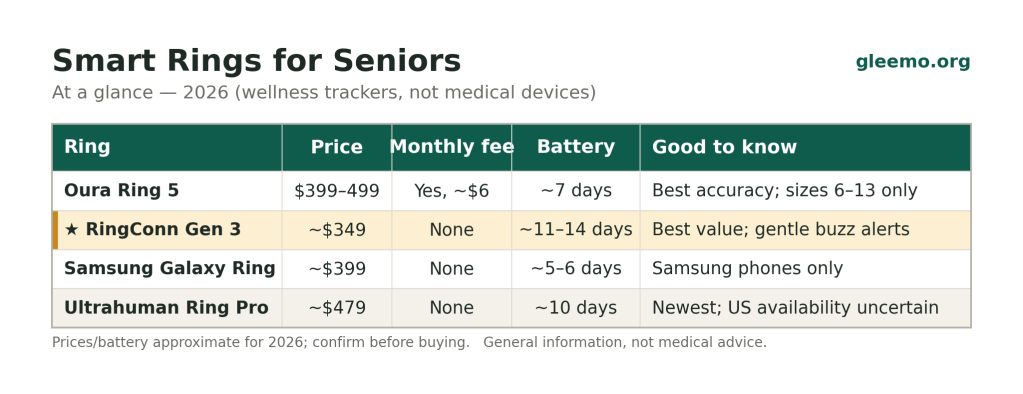
The best-known ring, and the only one with solid independent accuracy testing behind it. The newest version (June 2026) is 40% smaller — truly like a normal ring — with about a week of battery. The catches are real: it costs $399 to $499 and requires a subscription of about $6 a month just to see your data — roughly $216 over three years on top of the ring. It also only comes in sizes 6–13, so very small or large fingers are out of luck. Best for: people who want the most accurate tracking and the nicest app, and don’t mind an ongoing fee.
RingConn Gen 3 — the best value, no monthly fee
This is the sensible-default pick for most people. It’s around $349 with no subscription ever, the longest battery in the category at up to 14 days, and a built-in vibration motor that gently buzzes your finger for things like a low battery or a reminder — a genuinely nice touch if you don’t always have your phone in hand. It comes in sizes 6 to 15, fitting more people. The honest catch: the app and insights aren’t as polished as Oura’s, and its accuracy hasn’t been independently verified. Best for: anyone wanting long battery, no recurring fees, and straightforward sleep and health trends.
Samsung Galaxy Ring — only if you have a Samsung phone
Around $399 with no subscription — but it really only works well paired with a Samsung Galaxy phone, so iPhone users are out. One long-term reviewer also reported the battery weakening badly (to about two days) after a year, which is worth weighing. Best for: committed Samsung phone users.
Ultrahuman Ring Pro — newest, but a gamble
About $479, no subscription, very long battery — but it only reached the US weeks ago, it’s a little chunky, and an unresolved patent dispute could affect whether it stays available here. Best for: tech enthusiasts who enjoy being early adopters. For most folks, I’d wait.
The things the ads won’t tell you
A few honest points that apply to all of them:
- The battery won’t last as long as the box claims — real-world life runs about 15–25% short, and across every brand, batteries tend to weaken noticeably after a year or so. Plan to replace the ring every couple of years.
- A subscription adds up. Oura’s $6 a month is $72 a year — real money on a fixed income. The no-subscription rings cost more upfront but nothing after.
- No ring has been proven to make you healthier. They’re for awareness and curiosity, not guaranteed results.
- Sizing isn’t normal ring sizing. Always order the free sizing kit first.
- Your data may not be private. As we’ve covered before, the health data these rings collect generally isn’t protected by medical-privacy law — the company may share or even sell it. Read the privacy policy and limit the app’s permissions.
So which one?
- Best accuracy and app, don’t mind a monthly fee? → Oura Ring 5 (check your finger is size 6–13 first).
- Best value, long battery, no ongoing cost? → RingConn Gen 3 — for most seniors, the one I’d start with.
- Devoted Samsung phone user? → Samsung Galaxy Ring.
- Love being first and don’t mind the risk? → Ultrahuman Ring Pro.
The bottom line
A smart ring can be a lovely, low-fuss way to learn about your sleep and stay a bit more in tune with your body — as long as you remember it’s a companion, not a doctor. If you’re curious and want the least fuss and cost, the RingConn Gen 3 is a sensible place to begin. And whatever you choose, share anything that worries you with your doctor. That’s what turns an interesting number into real care.
Quick comparison below:

 GleemO
Leave a comment