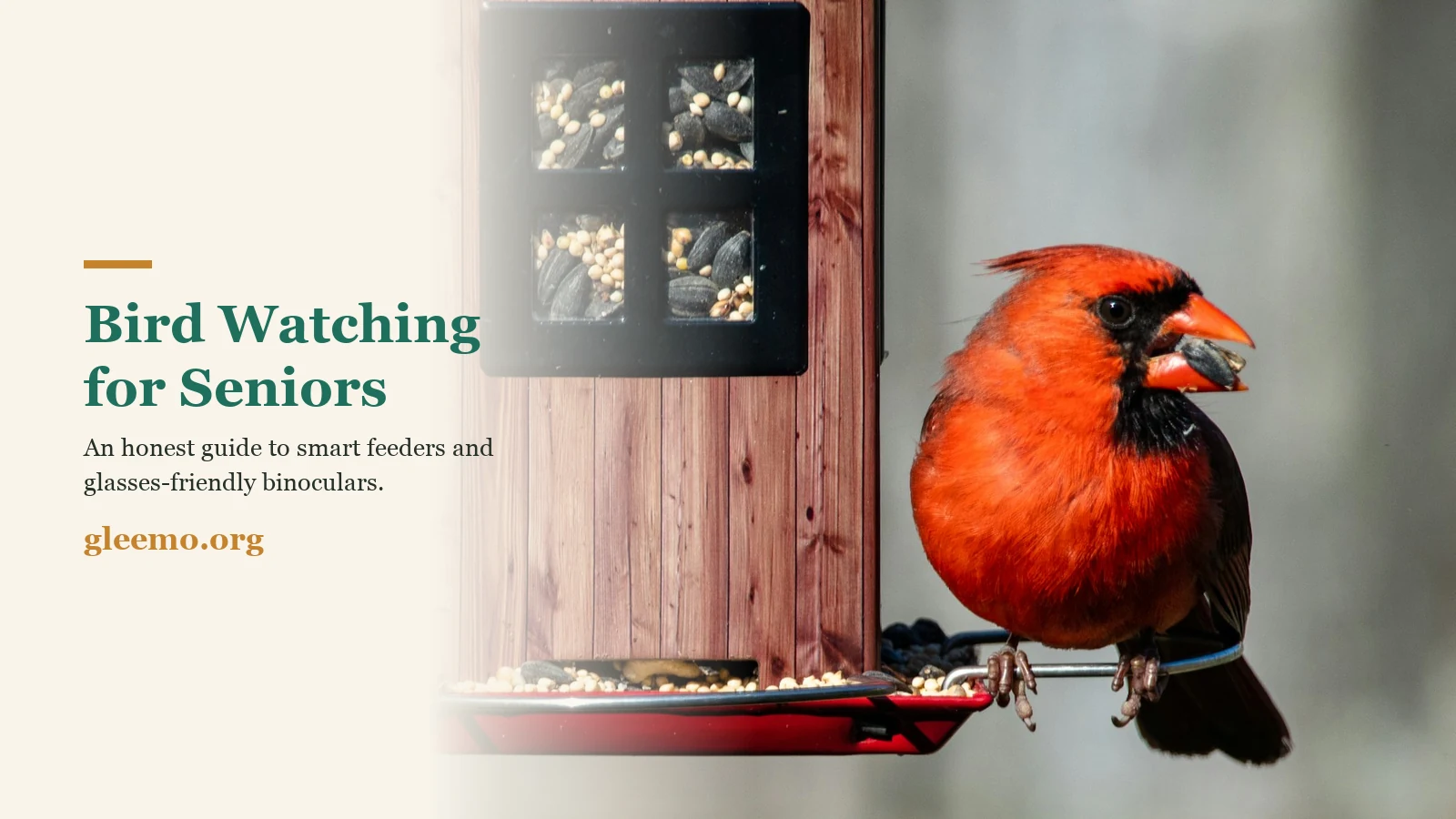
Can you still take up bird watching – or keep doing it – once a trail isn’t an easy walk anymore and your eyes aren’t what they used to be? Yes. Bird watching for seniors doesn’t actually require either one. What changes with age are two specific things: how easily you get outside, and how much fine detail you can see at a distance once glasses are part of the picture. Two different pieces of gear answer those two problems – a camera feeder that brings the birds to your porch or window, and binoculars built around one spec most buying guides never explain. You don’t need a generic "best binoculars" list here; you need to know which problem you actually have.
We’ve made this same case before: you can keep doing what you love as your body changes, whether that’s pickleball, fishing, or watching who shows up at your own feeder.
Gleemo isn’t a doctor or an eye doctor. This is buying guidance, not a substitute for an eye exam or your own eye doctor’s advice about your vision – and if you’re curious about birdwatching’s wellness benefits specifically, that’s worth asking your own doctor too. Prices, stock, and sale pricing below are current as of September 2026 and change often – confirm on the seller’s own page before you buy.
The Quick Answer: Which Bird-Watching Gear Solves Which Problem as You Age
Bird watching for seniors comes down to matching gear to whichever problem you actually have, not buying whatever’s trending:
- A camera feeder is for when getting outside is the hard part – it brings the birds to your phone instead.
- The right binoculars are for when you still get outside just fine, but can’t see detail through your glasses anymore.
- Some people genuinely want both, and that’s a fair answer too – there’s no rule that says pick one.
The rest of this guide covers both, honestly – including what’s actually for sale today versus what’s still just an announcement.
Smart Bird Feeders for Seniors: Bringing the Birds to You
What a Camera Feeder Actually Does for Someone Who Can’t Get to a Trail
A smart bird feeder is a regular feeder with a camera built in. Every visitor gets photographed or filmed, the image lands straight in an app on your phone, and the feeder’s AI takes its best guess at the species – the whole "porch to phone" pitch. There’s a real delight in a phone buzzing to tell you a cardinal or a chickadee just landed at your own feeder, especially on a day a trail walk isn’t in the cards. For someone who can’t easily get outside anymore, that’s the hobby itself, brought home.
Two things matter here. First, this only works with a smartphone and home WiFi reaching wherever the feeder hangs – no WiFi at that spot, no smart features, full stop. Second, the feeder doesn’t need to sit "in" a window, or even near one: it connects over your home’s 2.4GHz WiFi and pushes photos and video to your phone from anywhere within range of your router, so you can check the feed from any room, or away from home entirely.
Birdbuddy Pro Solar vs. Birdfy: Which Fits an Older Parent or Beginner Best
Bird Buddy announced a next-generation lineup at CES 2026 – "Bird Buddy 2" and "Bird Buddy 2 Mini" – and a lot of what you’ll find online still describes those press-release names and prices. The honest update: as of this writing, neither is actually for sale. They were announced, not shipping.
What Bird Buddy is actually selling right now is Birdbuddy Pro Solar – $189, marked down from a $339 list price, confirmed in stock. It includes the camera, a detachable solar roof, feeder body, mount, and free app access – you own the hardware outright, and with the solar roof attached, the battery rarely needs charging.
The free tier is genuinely functional, not a stripped-down trial: automatic photo and video capture, a live stream, and baseline AI species identification all work without paying. The optional "Family Premium" membership runs $98.99 a year (first month free, then it auto-renews) and unlocks sharing your feed with up to 10 family members and browsing other members’ public feeders – it is not a gate on identifying birds, which stays free either way.
The AI is good, not perfect: reviewers describe it as correct a fair amount of the time, but certainly not always, occasionally mislabeling a bird or returning "Unrecognized" on a common species in poor light. Skip any "world’s first" claim you see in smart-feeder marketing, too – similar camera-feeder technology existed elsewhere around the same time this category first launched. And Bird Buddy’s non-solar "Pro" feeder, though still listed at $124 (marked down from $249), is currently out of stock – you can’t actually buy it right now.
Birdfy is the real comparison, and its pricing moves around enough that one number would be misleading: roughly $99-150 for a base camera feeder, $120-220 for a solar bundle, depending on the promotion and generation running when you check. Confirm the current price at checkout rather than trusting any number you read online, including this one.
It’s the same logic behind a follow-me golf cart: the gear does the part your body can’t do easily anymore, so you can keep doing the part you actually love.
Who a Smart Feeder Is Really For (and Who Should Just Buy a Plain One)
A smart feeder earns its price for someone who can’t get outside as easily as they used to, wants the delight of a phone buzzing "you have a visitor," and doesn’t mind a simple app – it’s also a strong gift for an adult child to give a parent spending more time at home.
It’s the wrong buy if there’s no home WiFi reaching the yard, since the smart features simply won’t work no matter how good the camera is, or if you just don’t want an ongoing app or account relationship, even a free one. For either reader, a plain, non-camera feeder remains the simplest option of all: no app, no WiFi, no subscription, just birds.
| Product | Price | Free vs. Paid | Best For |
|---|---|---|---|
| Birdbuddy Pro Solar | $189, in stock | Free ID; $98.99/yr adds sharing | An older parent or beginner |
| Birdfy base camera feeder | roughly $99-150, varies by promotion | Free basics; confirm any paid tier at checkout | A tighter budget for a first smart feeder |
| Birdfy solar bundle | roughly $120-220, varies by generation | Same free-basics structure as the base feeder | Solar power at a lower entry price than Birdbuddy’s |
Note: Prices current as of September 2026 – confirm on the seller’s own site before buying. Birdbuddy’s non-solar "Pro" feeder is out of stock and isn’t listed above as a buying option. Bird Buddy’s newer "Bird Buddy 2" and "Bird Buddy 2 Mini," announced at CES 2026, aren’t confirmed shipping as of this writing.
What Older Birders Actually Report About Staying in the Hobby
Rather than invent a personal story, here’s what’s actually documented. Several accessibility researchers and patient-advocacy groups – independently of each other, not just one enthusiast blog – describe window and home-based bird watching as a genuine, dignity-preserving way to keep the hobby going once getting outside gets harder – the hobby itself, adapted to what’s actually changed, not a consolation prize.
Binoculars for Eyes That Have Changed
The One Spec Almost Nobody Mentions: Eye Relief for Glasses Wearers
Eye relief is the distance, in millimeters, between the eyepiece lens and the point your eye needs to be to see the whole field of view. Eyeglasses hold your eye 10-15mm farther from that lens than bare eyes do – why binoculars that felt fine before you needed glasses can suddenly show a dim, cropped circle instead of the full picture. Audubon and Cornell Lab’s own birding-optics guidance both recommend at least 15-16mm of eye relief for glasses wearers, more for thick lenses or bifocals.
The fix built into most modern binoculars is twist-up, twist-down eyecups: twist them down (retracted) when you’re wearing glasses, to close that gap, and up (extended) when you’re not.
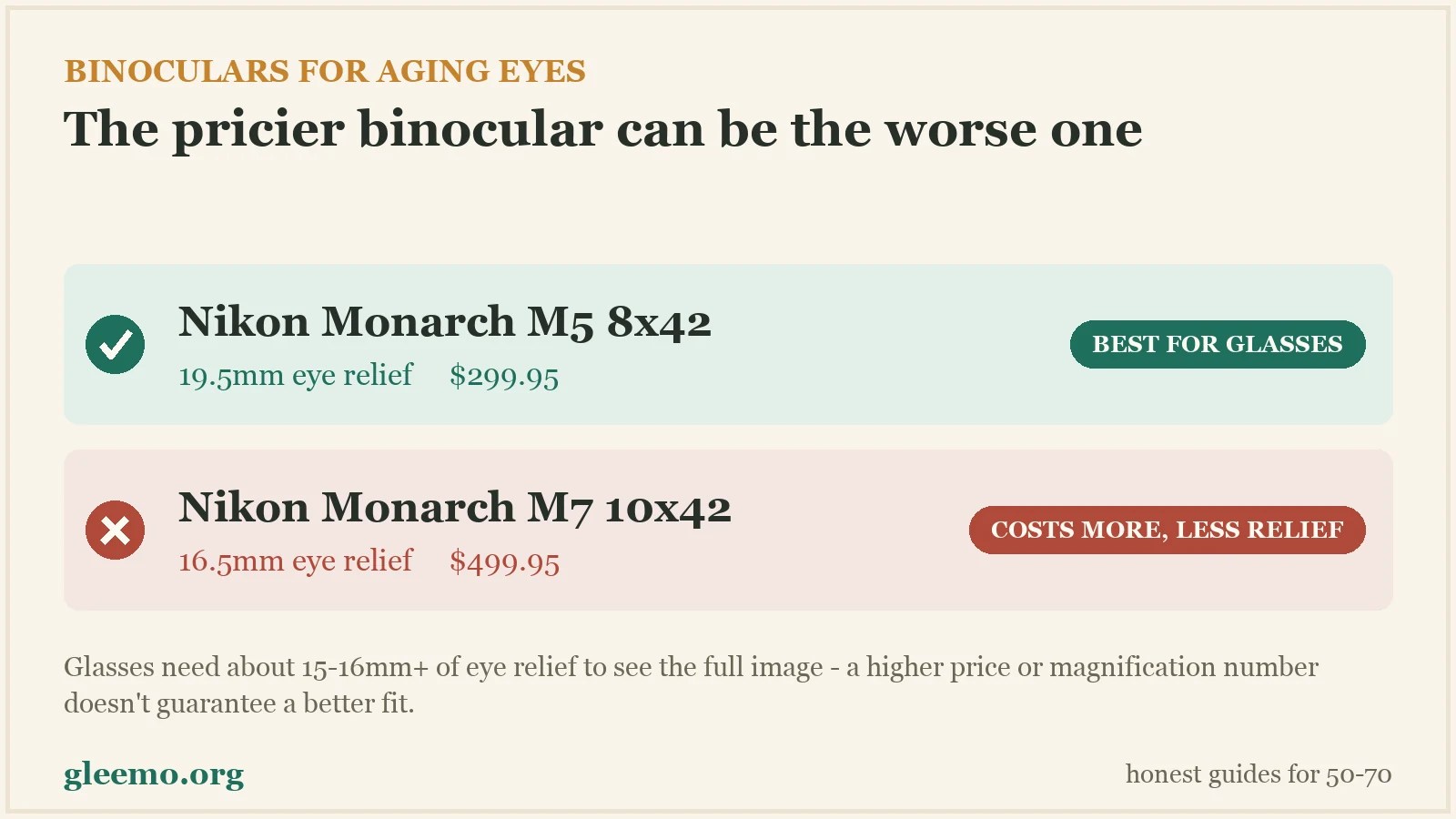
Here’s the counterintuitive part. The Nikon Monarch M5 8×42 has 19.5mm of eye relief – the class-leading figure among the models we checked – for $299.95. The Nikon Monarch M7 10×42, Nikon’s pricier, higher-numbered model, actually has less eye relief at 16.5mm, for $200 more ($499.95). A bigger price tag and a bigger magnification number don’t automatically mean a better fit for glasses – between these two, the cheaper Nikon is the better buy for eyeglass wearers.
There’s a real trade-off to be honest about, though. Cornell Lab’s own review of the Monarch M5 praises its optics as excellent, but found its field of view "substantially narrower" than the M7’s, giving "a sense of tunnel vision" that "can make it hard to find and follow birds" – a genuine cost of its excellent eye relief and lower price, not a reason to avoid it. And remember, mm specs are a strong guide, not a guarantee: frame shape and lens thickness affect real-world fit too, so trying binoculars on with your own glasses, where you can, is still the gold standard.
Weight and Grip: What Actually Matters for Arthritic or Unsteady Hands
Magnification affects more than image size – it affects how steady you need to hold the thing. 8x is the standard recommendation for beginners over 10x: it gives a wider field of view, roughly 25% more, making it meaningfully easier to find a moving bird and keep the image steady once you have it.
That’s the same grip-and-weight questions we asked about fishing gear – the tool has to work with the hands and arms you actually have, not the ones a spec sheet assumes. Worth saying plainly: if you have significant hand tremor or very limited grip strength, even a lighter 8×42 binocular may be too heavy to hold steady on its own. A tripod- or monopod-mounted binocular adapter, or a spotting scope on a stand, is the honest alternative in that case – not a lesser option, just a different tool for a different limiter.
A Solid Pick and a Budget Pick for Eyeglass Wearers
For eyeglass and bifocal wearers, the Nikon Monarch M5 8×42 ($299.95) is the pick – the eye relief above makes the case. If that’s more than you want to spend, the Celestron Nature DX 8×42 ($139.95) is a genuine budget pick, not a compromise dressed up as one: 17.5mm of eye relief, and Celestron’s own marketing calls it "eyeglass friendly," for less than half the Monarch’s price.
| Product | Eye Relief | Price | Best For |
|---|---|---|---|
| Nikon Monarch M5 8×42 | 19.5mm | $299.95 | The most eye relief for eyeglass and bifocal wearers |
| Celestron Nature DX 8×42 | 17.5mm | $139.95 | A genuinely eyeglass-friendly budget pick |
| Nikon Monarch M7 10×42 | 16.5mm | $499.95 | More magnification for birders who don’t wear glasses |
Note: Prices current as of September 2026 – confirm on Nikon’s or Celestron’s own site before buying. The M7 costs $200 more than the M5 and has less eye relief – a bigger price and a bigger magnification number don’t guarantee a better fit for glasses.
So Which One Do You Actually Need? An Honest Decision Framework for Older Birders
Plenty of people enjoy birds with nothing but a plain feeder and their own eyes – neither piece of gear here is required. But if you’re deciding where to spend money, here’s the honest framework.

A feeder alone is plenty if getting outside, not seeing detail, is your real limiter: at $189, Birdbuddy Pro Solar solves that completely, and the free species-ID tier means you’re not paying extra for the core magic of it.
Binoculars matter more if trail or travel birding is still part of your life, since a feeder only shows you your own yard. Here the honest range runs $139.95 (Celestron Nature DX) to $299.95 (Nikon Monarch M5), with no subscription or app to manage either way.
Some people genuinely want both, and that’s a fair answer, not indecision. It’s the same idea we covered with hearing: the right gear gets chosen for how a specific sense or ability has actually changed for you, not picked off a generic "best of" list built for nobody in particular. And if neither problem describes you, the honest answer is that you may not need to buy anything new at all.
A Gift Your Parent (or You) Will Actually Use
If you’re the adult child shopping for a parent who loves birds, match the gift to the problem they actually have, not to whatever looks impressive wrapped up.
If a trail isn’t the easy walk it used to be, or they simply spend more time at home now, Birdbuddy Pro Solar ($189) is the "birds come to you" gift – confirm they have home WiFi and a smartphone first, and know the optional $98.99/year Family Premium is purely a sharing add-on, not something they need to enjoy it.
If they still get outside fine but their old binoculars seem dimmer or more cramped than they remember, the real problem is eye relief, not enthusiasm: the Nikon Monarch M5 8×42 ($299.95) is the strongest gift for that, and the Celestron Nature DX 8×42 ($139.95) is a genuinely good one if you’d rather keep it under $150.
Not sure which describes them? Ask: "Can you still get out to where the birds are, or has that gotten harder?" is a more useful gift-shopping question than anything on a review site.
Bird Watching for Seniors: Frequently Asked Questions
Is a Bird Buddy worth it for an older parent?
For a parent who can’t easily get outside anymore, yes. The free tier – photo/video capture, live stream, and species ID – genuinely works without paying, and Birdbuddy Pro Solar ($189, marked down from $339 as of September 2026) is the current, in-stock model. Skip it if there’s no home WiFi reaching the yard.
What eye relief do binoculars need if you wear glasses or bifocals?
Aim for at least 15-16mm, more for thick lenses or bifocals – glasses hold your eye 10-15mm farther from the lens than bare eyes do, so you need extra distance to see the whole image. The Nikon Monarch M5 8×42’s 19.5mm is the class-leading figure among the models covered here.
Can you go bird watching if you have limited mobility?
Yes. A smart camera feeder brings the hobby to a window or porch with nothing more than home WiFi and a smartphone – no trail required. Accessibility researchers independently describe window and home-based bird watching as a genuine way to keep doing the hobby, not a lesser version of it.
What’s the best magnification for a beginner birder?
8x over 10x. It gives a wider field of view – roughly 25% more – and is easier to hold steady, making it easier to find and follow a moving bird in the first place.
Do smart bird feeders work through a window?
They don’t need to be mounted in a window, or even near one. Bird Buddy- and Birdfy-style feeders connect over your home WiFi and send photos and video to your phone from anywhere within range of your router.
What’s a good gift for someone who loves birds?
Match it to the actual problem: Birdbuddy Pro Solar ($189) brings the birds to a parent who can’t get outside as easily, while the Nikon Monarch M5 8×42 ($299.95) or budget Celestron Nature DX 8×42 ($139.95) fixes a dim, cropped view for someone who still gets out but struggles with glasses.
The Honest Bottom Line
Bird watching for seniors doesn’t need a trail or perfect eyesight – it needs gear matched to whichever specific thing has actually changed. A camera feeder solves a mobility problem. The right binoculars, chosen for eye relief instead of price or magnification, solve a vision problem. Neither one is required, and some people are happy with neither – a plain feeder and your own eyes remain the cheapest, simplest way into this hobby, exactly as they always were.
Gleemo has more honest, no-upsell guides like this one at gleemo.org.
