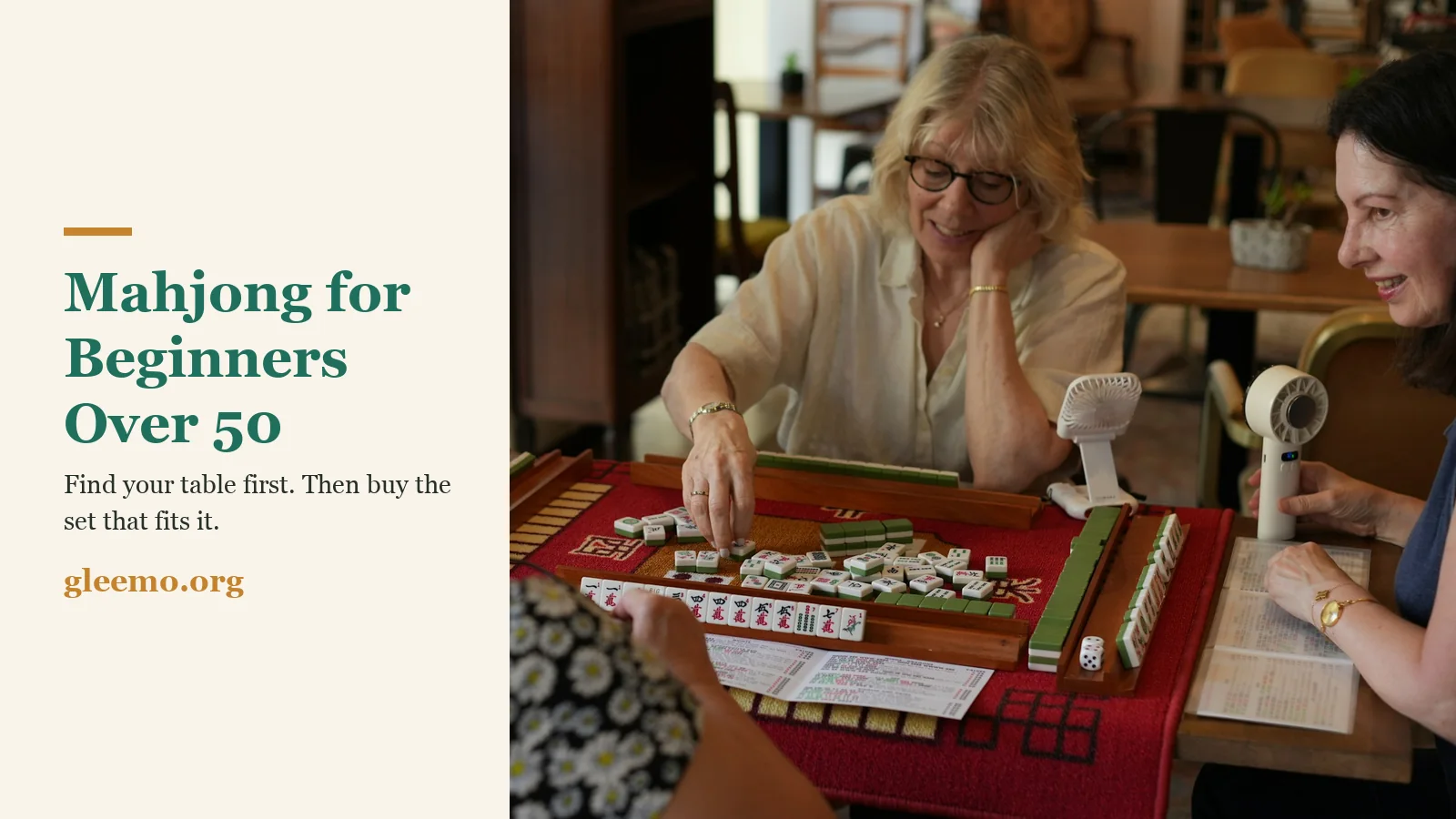
Mahjong for beginners over 50 usually starts with the wrong first move: buying a set. If everyone at your clubhouse or senior center is suddenly talking about mahjong, the honest first step isn’t a box of tiles – it’s finding a table. The variant your group plays decides which set you need, and buying before you know that can mean owning tiles that don’t work at your table at all. If your mother or grandmother played, you can probably already picture the clack of tiles before a new hand. This guide walks the path in order: how the tile-matching game on your phone differs from the real one, how to learn the rules, where to find a beginner-friendly table, and only then, which set is worth buying. If you’re building a list of things to try after 50, bird watching is one of Gleemo’s other low-cost hobbies worth picking up.
The Mahjong on Your Computer Isn’t the Mahjong at the Table
The tile-matching game you’ve played on a phone or computer is real, and it isn’t a beginner version of the game at the senior center. Mahjong solitaire was created in 1981 by Brodie Lockard on the PLATO computer system and given away for free. Activision’s "Shanghai" turned it into a commercial hit in 1986, selling around 10 million copies, and Microsoft later built its own version into Windows, from "Taipei" through "Mahjong Titans" to today’s "Microsoft Mahjong." In solitaire, one player clears matching pairs of exposed tiles from a layout. That’s the whole game.
The mahjong your neighbors are learning is different in almost every way: four players draw and discard tiles, building a hand through strategy and scoring, at a table with racks, a card, and other people. Despite sharing a name, the two games are functionally unrelated. If solitaire is the only mahjong you know, you’re not behind – just about to learn a different game.
How to Learn Mahjong for Beginners Over 50
The fastest way to learn the four-player game is a live table, not a screen. Here’s how the common ways to learn compare, and what your first sessions will likely feel like.
A Real Teacher vs. an App vs. YouTube: What Each Is Good For
A teacher or class – JCC, senior center, or community group – is the most direct route: you watch real hands get built, get corrected in the moment, and pick up table habits, like calling a tile or exposing a meld.
An app or rules guide works well as homework – tile names, suits, and basic scoring – so the table isn’t your first exposure to the vocabulary.
YouTube videos show the pace of real play, but can’t correct a mistake. Most beginners do best combining a little reading or video with an actual table.
What to Expect at Your First Few Games
The rules take more than one sitting to click – normal, since American mahjong has real strategy and scoring to absorb. Beginner classes exist for this reason, and an experienced table is usually patient with someone new. Expect to ask questions; "why can I take that tile?" is a normal first-session question. Give it more than one sitting before deciding whether it’s for you.
Find Your Mahjong Table Before You Buy a Set
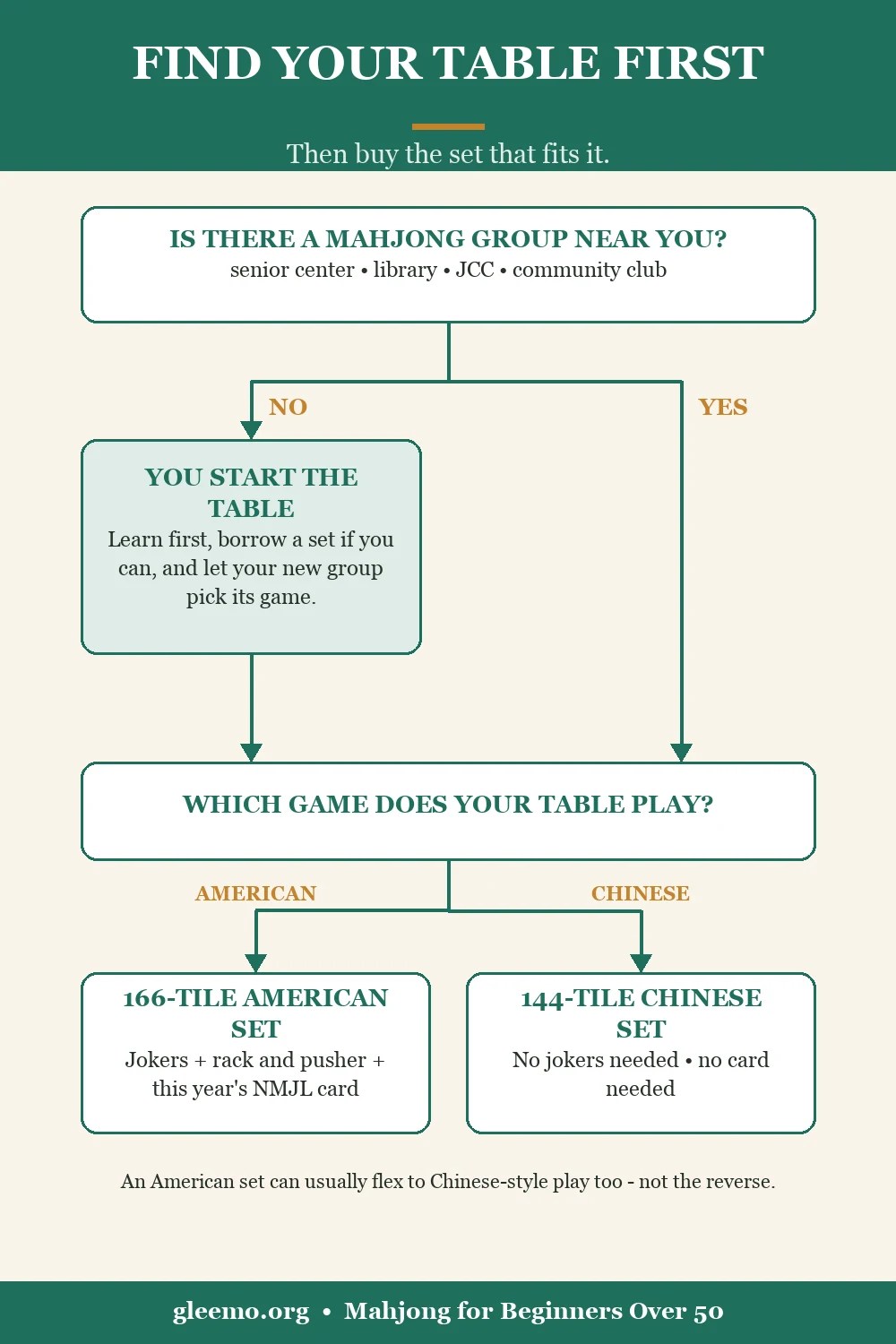
This is the step most buying guides skip. The variant your table plays decides which set you need, so the smartest first move costs nothing: find the table before you find the tiles.
Senior Centers, JCCs, and Community Groups
Senior centers and public libraries are a real, common route to a beginner table. Call and ask what’s currently running, since offerings vary and change with the season.
Jewish Community Centers (JCCs) are also a strong bet: several run dedicated beginner mahjong classes, though schedules rotate seasonally, so call ahead rather than assume one is running.
One honest caveat: the National Mah Jongg League doesn’t run a public directory of clubs or teachers – there’s no single list to search. Finding a table really is call-around work: senior center, library, JCC, community club, and anyone you already know who plays.
What to Bring to Your First Session
Call ahead and ask if the group has a loaner set or house tiles, so you don’t need to own anything yet. Plan to sit for an hour or two, and bring your questions. A first session is for learning, not performing – every player at that table started where you’re starting.
Which Mahjong Set to Buy, Once You Know Your Table’s Game
Once your table has told you its game, the set decision gets easier. If you’re shopping for a mahjong set for seniors, size, contrast, and grip matter as much as tile count – and the wrong count means a set you can’t use.
American vs. Chinese Sets: Which to Buy for a New Senior Group
The two set types are not interchangeable, and the difference isn’t cosmetic.
American Mah Jongg uses 152 tiles in its strict rule count, and commercial "American" sets typically package 166 pieces (the extra 14 are spare flowers, jokers, and blanks). It’s played with a rack with a sliding pusher, which hides your tiles while the flat top shows anything you’ve exposed.
Traditional Chinese mahjong uses 144 tiles and has no jokers – that’s where the 8-tile gap between the two games comes from. It’s typically played without a rack, tiles held by hand.
The part that matters for your wallet: a Chinese 144-tile set cannot be used for the American game – it’s missing the jokers required, and usually the rack too. An American set can generally also be used for Chinese-style play; one manufacturer’s own listing for its 166-tile set says plainly that it’s "playable with both American and Chinese Mahjong rules." If there’s any chance your table might play either game, an American set is the safer buy.
The Readable-Tile Checklist for Eyes and Hands 50 to 70
Two sets with the same tile count can still be very different to actually play with. Before you buy, run any set through this checklist:
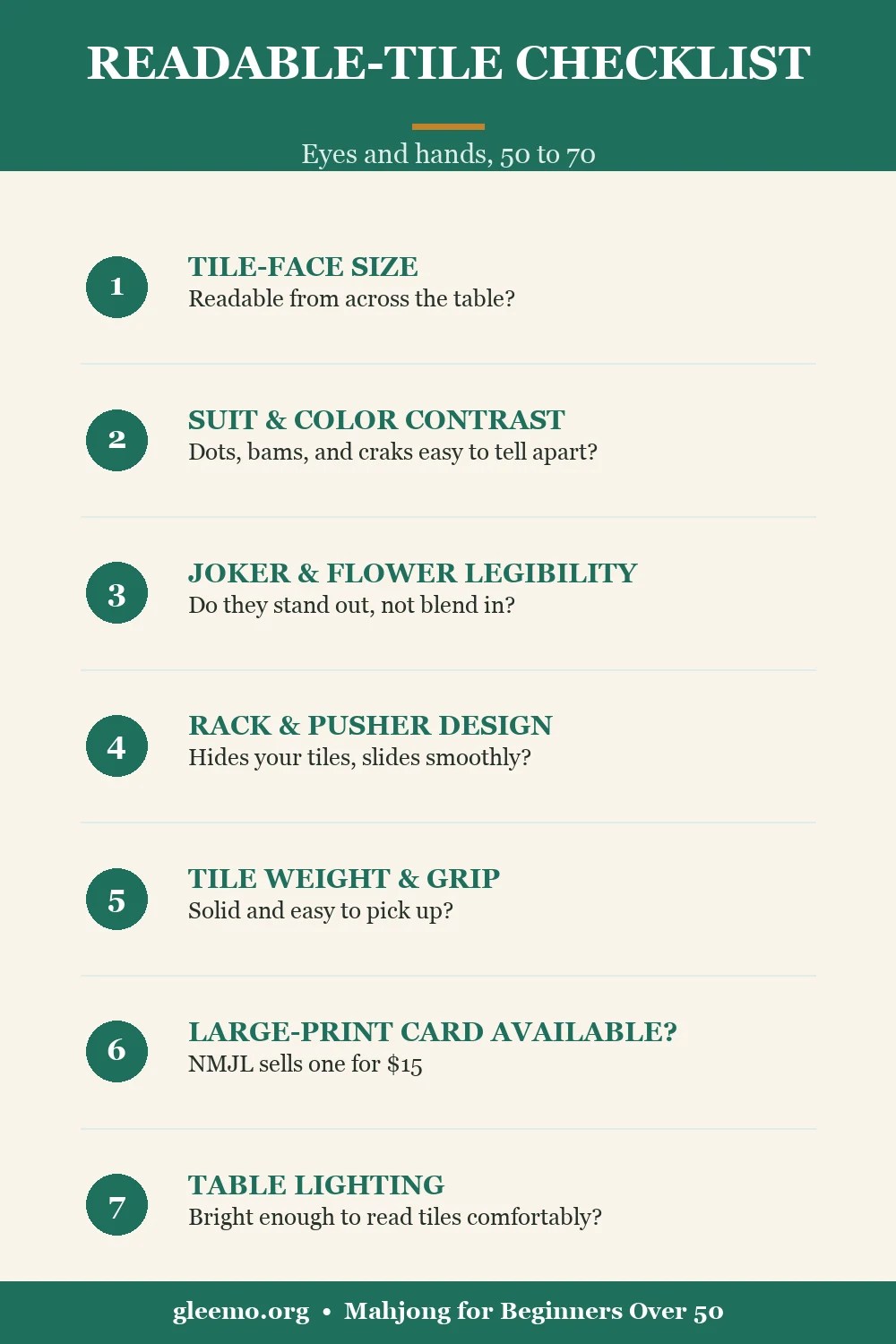
- Tile-face size: readable from across the table
- Suit and color contrast: dots, bams, and craks easy to tell apart
- Joker and flower legibility: should stand out, not blend in
- Rack and pusher design: hides tiles, slides smoothly
- Tile weight and grip: solid, easy to hold
- Large-print card availability for your game
- Table lighting: bright enough to read comfortably
If aging hands make grip a real factor in the hobbies you choose, you’re not alone – fishing is another hobby that’s easier on aging hands.
Large-Print and Easy-Read Tiles: Worth the Extra Cost, or Not
Yes, a genuine large-print option exists. Where The Winds Blow sells a 164-tile "Large Print Solid White" American set, marketed for vision needs, for $225.00 on sale ($275.00 regular) as of 2026-09-24 – confirm current pricing before you buy. A full-custom large-print order runs up to $450.00. It’s real and currently in stock, but costs well more than a standard set – worth knowing up front.
The National Mah Jongg League sells a large-print card too: $15.00 for the 2026 card, a dollar more than the standard $14.00 card.
One caution: you may see engraved or high-contrast designer tiles marketed online. One such set, reviewed independently, is described by its own reviewer as "not an assistive device," and was pre-order, not general stock, at last check. Pretty and readable aren’t automatically the same thing – the checklist above is what tells you.
| Set Tier | Variant | What’s in the Box | Readability | Price (as of 2026-09-24, verify current price) |
|---|---|---|---|---|
| Budget | Chinese/traditional | 144 tiles, no jokers, often no rack or pusher | Standard-size characters; no large-print version found | Not independently confirmed – check current listing |
| Mid (top pick) | American | 166 tiles (152 required plus spares: extra jokers, flowers, blanks), rack with sliding pusher | Standard-size characters, jokers clearly marked | $149.99-$299.99 |
| Easy-read | American | 164 tiles, large-print characters, marketed for vision needs | Largest characters of the three tiers, high contrast | $225.00 sale ($275.00 regular); custom up to $450.00 |
| Gift/designer | American, tiles only | Tiles only – no rack, card, or pusher included | Standard readability; valued for design, not legibility | $375.00-$495.00 |
Note: Prices as of 2026-09-24 – confirm on the vendor’s own page before buying. A Chinese/traditional 144-tile set cannot be used for American/NMJL play – it lacks the required jokers and usually the rack. There is no "best" pick in the gift/designer tier; premium buys you look, not gameplay.
Ready to compare real listings? Check current price: Yellow Mountain Imports American mahjong sets or Check current price: Where The Winds Blow large-print tiles.
What a Starter Mahjong Set Really Costs in the First Year
Here’s the fine print the cheapest listings don’t mention: the bargain sets you’ll find first online are almost always the 144-tile Chinese format, not American. If your table plays the American game, that "deal" is the wrong purchase, because no jokers means you can’t build the hands your table needs.
If your table plays American mahjong, the real first-year cost has two parts: the set, and the National Mah Jongg League’s official card, republished every year with new winning hands. Because your table’s hands come from the current card, most groups budget for it annually – it isn’t a legal requirement to play, but it’s what keeps everyone on the same hands.
| Path | Upfront Cost | Recurring Cost | First-Year Total |
|---|---|---|---|
| Free / learn-first (senior center, library, JCC, or a borrowed set) | $0 | $0 | $0 |
| Standard American set (cheapest, 166 tiles) + NMJL standard card | $149.99 | $14.00 | $163.99 |
| Large-print/easy-read American set (sale price) + NMJL standard card | $225.00 | $14.00 | $239.00 |
| Most expensive in-line American set + NMJL standard card | $299.99 | $14.00 | $313.99 |
Note: Prices as of 2026-09-24 – confirm on the vendor’s own page before buying. The large-print set’s regular, non-sale price is $275.00, which would put that total at $289.00. No verified price exists for a Chinese-format budget set, so it isn’t included here, and it wouldn’t work for an American table regardless.
None of this is required before you play a single hand. The free path costs nothing and answers the only question that matters: whether you like the game enough to buy anything. Optional extras – a rack-and-pusher set, a table cover – exist too, but price them only after you own a set you like.
Frequently Asked Questions
Is mahjong hard to learn as a beginner?
It has more rules than the tile-matching game most people know, but it’s not out of reach. Most beginners find it clicks with repetition – a class, a patient table, or both – rather than in one sitting. Give it more than one try before you decide.
What’s the difference between American and Chinese mahjong sets?
American sets have 166 tiles (152 required, plus spares) including jokers, and are played with a rack that has a sliding pusher. Chinese sets have 144 tiles, no jokers, and are played without a rack. A Chinese set can’t be used for American play; an American set can generally also be used for Chinese-style play.
How many tiles do I need to start playing?
American Mah Jongg uses 152 tiles in its strict count, and commercial sets usually include 166, with spares. Traditional Chinese mahjong uses 144 tiles. Which one you need depends on which game your table plays, so find that out before you buy.
Where can I find a mahjong group near me?
Start with your senior center and public library, then check whether a local JCC runs a beginner class – several do, though schedules rotate seasonally. There’s no national directory to search, so this is call-around work.
Is mahjong the same as the mahjong game on my computer?
No. Mahjong solitaire is a one-player game where you clear matching pairs of tiles from a layout. It shares a name with the real thing, but the four-player game beginners learn at senior centers and clubs is a different, turn-based game with scoring – despite Activision’s 1986 "Shanghai" and Microsoft’s later versions popularizing the solitaire format under the same name.
For more on trying something new after 50, see pickleball after 60 with bad knees, one of Gleemo’s other guides to getting active again.
This week, call your senior center or library and ask if they have a beginner mahjong table. Sit in once, then come back to the set guide above. The rest of Gleemo’s honest, no-upsell guides are waiting at gleemo.org.
