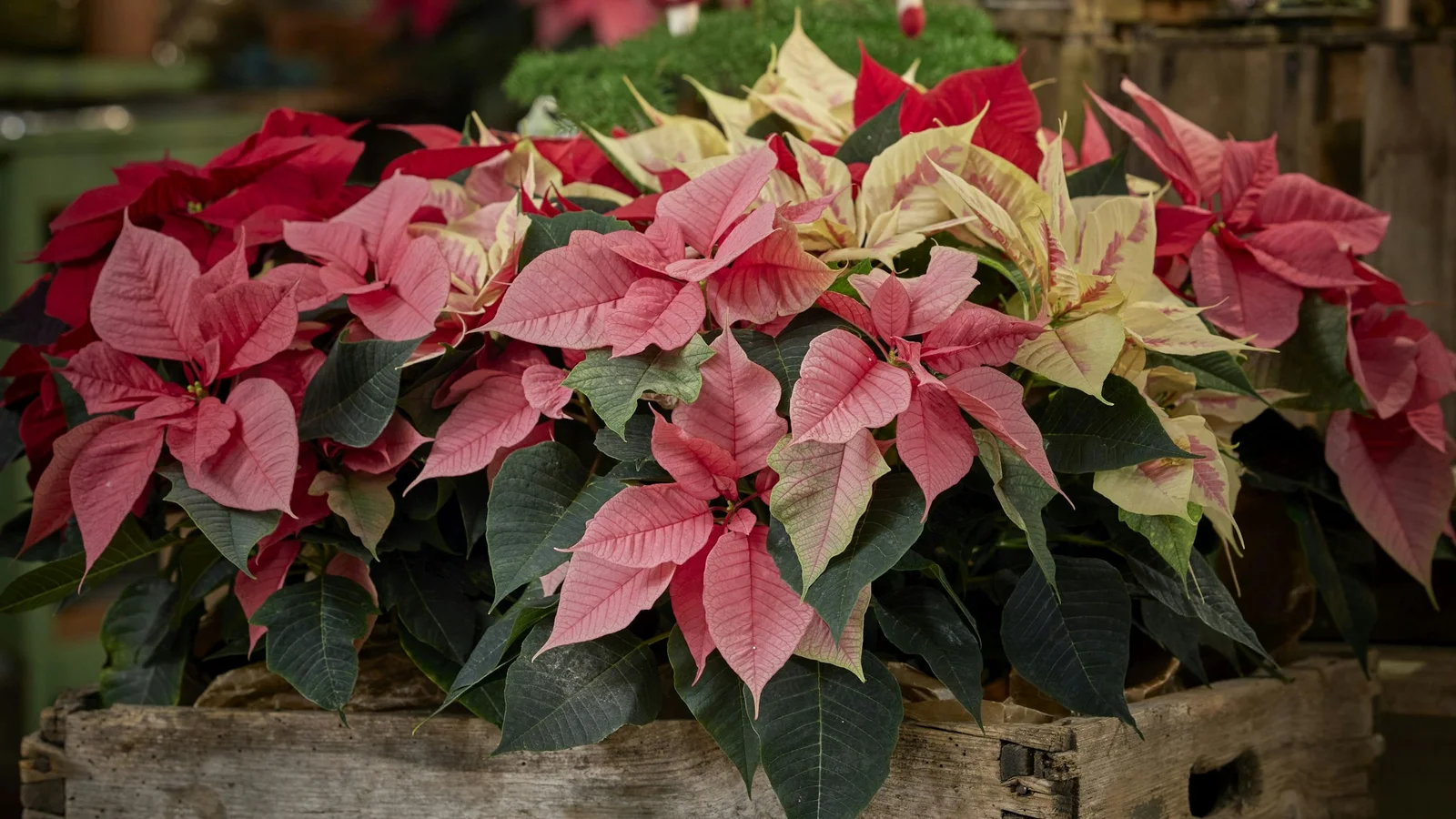
For anyone hosting the holidays or bringing a plant to mom, grandma or a neighbor: how to pick a healthy one, keep it looking good through December, and get it to bloom again next year.
The Christmas plants most people bring home are the Christmas cactus, the poinsettia and the amaryllis, and they all want the same start: bright light, no drafts, and water only when the soil asks for it. Next year is where they split. The cactus needs long dark nights or cool nights to bloom again. The amaryllis needs a rest. The poinsettia is hard to bring back, and it is fine to enjoy it through the holidays and let it go.
This guide covers all three, for the host with a full house and the grown kid carrying a plant to mom’s. If you have lost a poinsettia before, you are in good company.
Checked November 2026. Care advice from university extension pages and botanic gardens was read on November 16, 2026. Where sources give different numbers, we print each number with its source name.
Some links in this guide are affiliate links. If you buy through one, we may earn a small commission at no extra cost to you. It never changes what we recommend. As an Amazon Associate I earn from qualifying purchases. We earn nothing from a plant you buy at a garden center, a grocery store or a school or church fundraiser, from a cutting you take from a friend’s plant, or from the free extension pages we cite. Amazon sets prices and changes them often, so we do not print them here. We did not test these products; we read each Amazon listing in November 2026.
The short version
- Pick: a poinsettia with dark green leaves and bright bracts with no yellow or brown edges; a cactus with buds and no open flowers; ask for a sleeve to protect it from the cold.
- Place: bright but not harsh light, away from drafts, heat vents and cold glass.
- After Christmas: the cactus keeps going, the amaryllis can rest and bloom again, and the poinsettia is fine to compost when you are ready.
- Tell the cacti apart: look at the edges of the flat stem segments. Pointed teeth mean a Thanksgiving cactus, and most "Christmas cactus" sold are Thanksgiving cactus.
- Pets: the ASPCA (American Society for the Prevention of Cruelty to Animals) lists the Christmas cactus as Non-Toxic to dogs and cats, and the poinsettia and amaryllis as Toxic. Details and the phone number are below.
Which Christmas Plants Are Which? The Three at a Glance
Here are the three plants side by side. Every cell comes from a named extension page, a named seller or the ASPCA, read November 16, 2026.
| Plant | What you buy | Light | Water | Rebloom next year | ASPCA listing |
|---|---|---|---|---|---|
| Christmas cactus | A leafy plant, ideally with buds | Bright but filtered (UMN) | When the top half of the soil feels dry (Purdue) | Possible: needs long dark nights or cool nights | Non-Toxic to Dogs, Non-Toxic to Cats |
| Poinsettia | A plant in color; the color is bracts | Bright daylight, out of direct sun (UMN) | When the surface is dry; let it drain (Iowa State) | Hard (UMN) | Toxic to Dogs, Toxic to Cats |
| Amaryllis (bare bulb) | A bulb, often in a kit with a pot | Once it blooms, a cooler spot out of direct sun makes the flowers last (Iowa State) | Barely moist at first, more once growth shows (Iowa State) | Possible: needs a rest | Toxic to Dogs, Toxic to Cats |
| Waxed amaryllis | A bulb sealed in wax | Bright, indirect sunlight (Jackson & Perkins) | None while in wax (NC State) | Sources disagree | Amaryllis entry: Toxic to Dogs, Toxic to Cats |
Note: UMN is University of Minnesota Extension; Purdue is Purdue Extension; NC State is North Carolina State Extension; Iowa State is Iowa State Extension; Jackson & Perkins is a plant seller. The ASPCA also lists these plants as Toxic or Non-Toxic to Horses. Read November 16, 2026.
The Christmas cactus is not cared for like a desert cactus: bright filtered light, a well-drained mix, and soil that dries partway between waterings.
How to Pick a Healthy Plant at the Store
A few seconds of looking before you pay saves a lot of December worry.

Our store checklist card.
Poinsettia: what to look at on the stem, bracts and soil
Iowa State’s advice, read November 2026, is to look for dark green foliage and bright bracts with no yellow or brown spots or edges. The bracts are the colored parts that look like petals. The true flowers are the small yellow-to-green buttons in the center (the cyathia, per UMN), and Iowa State says they should be shedding little or no pollen. Colorado State University (CSU) says plants with tightly closed flowers last longest.
Skip a plant that is wilted, has few lower leaves, has broken stems or shows insects. Many big box stores do not wrap their plants, per Iowa State, so ask for a sleeve.
Christmas cactus: buy it with buds
For a Christmas bloom, the University of Wisconsin’s advice is to buy a cactus with buds and no open flowers in late November.
Amaryllis: a large, solid bulb
Iowa State says to select large, solid bulbs, and that the largest bulbs usually produce 2 or 3 flower stalks.
The ride home: cold car, cold parking lot, and a sleeve
The trip from the store is where a poinsettia meets its first cold. Iowa State says to buy it at the end of your shopping trip, wrap or sleeve it before you go outside, and keep it in a heated vehicle. Its guide says: "Exposure to freezing temperatures, even for a brief moment, may cause the leaves to blacken and drop."
UMN says: "Poinsettias will suffer damage if they are exposed to temperatures below 50 degrees Fahrenheit. Freezing temperatures will kill poinsettias." CSU says to keep it above 55 F (Fahrenheit). The rule is the same: do not leave it in a cold car.
Poinsettia Care Through the Holidays
A poinsettia in the right spot will keep its color for several weeks, per Iowa State. Other sources give longer: Iowa State’s FAQ says 2 to 3 months, CSU says into mid-March and Utah State University (USU) says into March or April. We would say several weeks to a few months.
Light, water and where to put it in a full house
Put it in a south, east or west window with bright daylight and no direct sun, per UMN and the US Botanic Garden (USBG). USU and CSU say at least six hours of indirect light. Iowa State says 60 to 70 F is a good range, and UMN says 65 to 70 F is ideal.
Keep it away from cold drafts, heat ducts, fireplaces, fans, space heaters and cold window glass (UMN, USBG, Iowa State).
Water when the surface is dry to the touch, until it flows from the bottom, and never let water sit in the foil cover (Iowa State). USU says poinsettias are very sensitive to overwatering, and the USBG says: "When a poinsettia’s leaves start to droop, it is too dry."
Why poinsettia leaves fall off
Most often watering, says Iowa State: too much yellows and drops the lower leaves, too little wilts the plant. Warm, dry air from vents, drafts and door swings can do it too. Check the soil first.
After Christmas: keep it, rebloom it, or let it go
Here is the honest part. UMN says bringing a poinsettia back to color "is not an easy task, as it requires excluding light from the plant for some time while keeping the plant healthy." No source we read gives a success rate. Iowa State’s advice is to compost it when you are tired of it or it looks unattractive. That is a perfectly good ending.
If you want to try, the sources differ, so here is each one with its name:
- Iowa State: cut it back in March to 4 to 6 inches, move it outdoors in late May, then give it complete darkness from 5 pm to 8 am (15 hours, our arithmetic) starting in early October until the bracts color, usually early December.
- UMN: starting on or near September 21, give 16 hours of uninterrupted darkness and 8 hours of bright light every day.
- USU: beginning the first of October, a minimum of 14 hours of darkness, and "by the end of November, it will start to color."
Treat it as an experiment, not a promise.
Christmas Cactus Care: Keep It Looking Good
Light, water and soil
Give it bright but filtered light, UMN says; Penn State says full sun can damage it. For water, Purdue’s advice is to "water them thoroughly when the top half of the soil in the pot feels dry to the touch." UMN says to let the soil dry out between waterings, drain the pot in a sink and empty the saucer afterward.
Top or bottom? Penn State says to water from the top down. We did not find a source that recommends bottom watering.
For soil, UMN’s mix is 1 part potting soil, 2 parts peat and 1 part sand or perlite. The New York Botanical Garden (NYBG) says 1 part sand or perlite per 3 parts potting mix. Iowa State says "a special cactus mix is not required," and UC Master Gardeners say any good potting soil will do. The common cause of death is root rot from wet, heavy soil, per UF/IFAS (University of Florida Institute of Food and Agricultural Sciences). So the free advice is a regular potting mix, with perlite or sand added if you like.
UMN and Illinois Extension give days at 65 to 70 F and evenings at 55 to 65 F.
What the leaves are telling you
- Red leaves: UC Master Gardeners say red leaves are a warning sign: too much sun, a heavy bloom or overwatering.
- Limp or shriveled leaves: can mean too wet (UMN, Illinois) or too dry (UConn, University of Connecticut). Check the soil before you do anything else.
- Buds dropping: drafts, sudden temperature or humidity changes, moving the plant while buds form, too much water, dry soil, or too many buds (UMN, NYBG, Iowa State, UConn). Iowa State says not to move it while buds form, and to move it once "the first flowers begin to open."
Feeding and repotting
Repot only when needed, in spring or early summer, not in bloom; it blooms best a little pot-bound (UMN, Iowa State). Feed monthly from June to August at half strength (UMN, UF/IFAS). A well-kept cactus can last a very long time. Penn State describes holiday cacti with "lifespans that exceed one hundred years when properly tended," and UConn says it is "not uncommon for them to live for decades."
How to Get a Christmas Cactus to Bloom Again Next Year
The cool, dark nights rule, month by month
Two things push a cactus to set buds: long dark nights, and cool nights. The sources agree on that and differ on the numbers, so here are the ones we trust most.
- UMN: with cooler nights of 55 F, bloom comes in approximately 5 to 6 weeks, "sometimes regardless of the day length." With nights of 60 to 65 F, give "at least 12 hours of complete darkness every night for about 6 weeks." It is "unlikely to bloom if exposed to night temperatures above 65 degrees Fahrenheit."
- Purdue: it needs "long, uninterrupted dark periods," and the dark treatment should begin about mid-October. Purdue says it will also bloom if given cool nights of about 50 F to 55 F. In other words, dark or cool.
- Iowa State: some cultivars may bloom with as little as 12 hours of darkness.
Other sources run higher or lower: UConn says 12 to 14 hours for 4 to 5 weeks, NYBG 13 hours, and Iowa State’s "All About" page 14 to 16 hours. Pick one source and stick with it. Our summary, which is ours and not a quote: about 12 or more hours of unbroken dark each night for roughly 5 to 6 weeks, cool nights, started in early to mid-October.
Here is the year at a glance.
| When | Christmas cactus | Poinsettia | Amaryllis |
|---|---|---|---|
| This Nov to Dec | Do not move it while buds form (Iowa State) | Enjoy it; water when the surface is dry | Potted in early to mid-November, blooms for Christmas (Iowa State) |
| Jan to Feb | – | Color lasts several weeks to a few months (Iowa State, CSU, USU) | After bloom: cut faded flowers, keep the leaves, feed every 2 to 4 weeks (Iowa State) |
| March | – | Cut back to 4 to 6 inches if you try a rebloom (Iowa State) | – |
| Spring to early summer | Repot only if needed (UMN, Iowa State) | Outdoors in late May (Iowa State) | – |
| June to August | Feed monthly at half strength (UMN, UF/IFAS) | – | – |
| September | – | Darkness starts about Sept 21 (UMN) or Oct 1 (USU, Iowa State) | Late September: stop watering, rest it (Iowa State) |
| October | Dark or cool nights begin about mid-October (Purdue) | Nightly darkness continues | Rest: 8 to 10 weeks (Iowa State) or 8 to 12 weeks (UMN) |
| Next Nov to Dec | Blooms | Color by the end of November (USU) or early December (Iowa State) | Water again to restart |
Note: Sources as named, read November 16, 2026. A dash means our sources gave no step for that month.
Why it did not bloom this year
Iowa State’s FAQ gives the top reasons: lights on at night in the fall, temperatures above 70 F, or a plant that was moved or sat in a draft while it was in bud. Illinois Extension says flower buds will not be set if the darkness is interrupted for too long (2 or more hours).
Christmas Cactus, Thanksgiving Cactus or Easter Cactus: How to Tell
Look at the leaf edges
The leaves are really flat stems, called segments. North Carolina State calls their edges "the most important and reliable difference."
- Thanksgiving cactus: pointed teeth along the edges (Illinois Extension); NC State calls the edge toothed, with sharply defined teeth.
- Christmas cactus: scalloped and rounded, with no pointed teeth.
- Easter cactus: very rounded edges, with bristles on the top of the segments (NC State).
Flowers help too: Thanksgiving and Christmas are tubular and Easter is star-shaped (Illinois). Illinois and Penn State add that the anthers (the tips that hold pollen) are yellow on a Thanksgiving cactus and purplish-brown on a Christmas cactus.
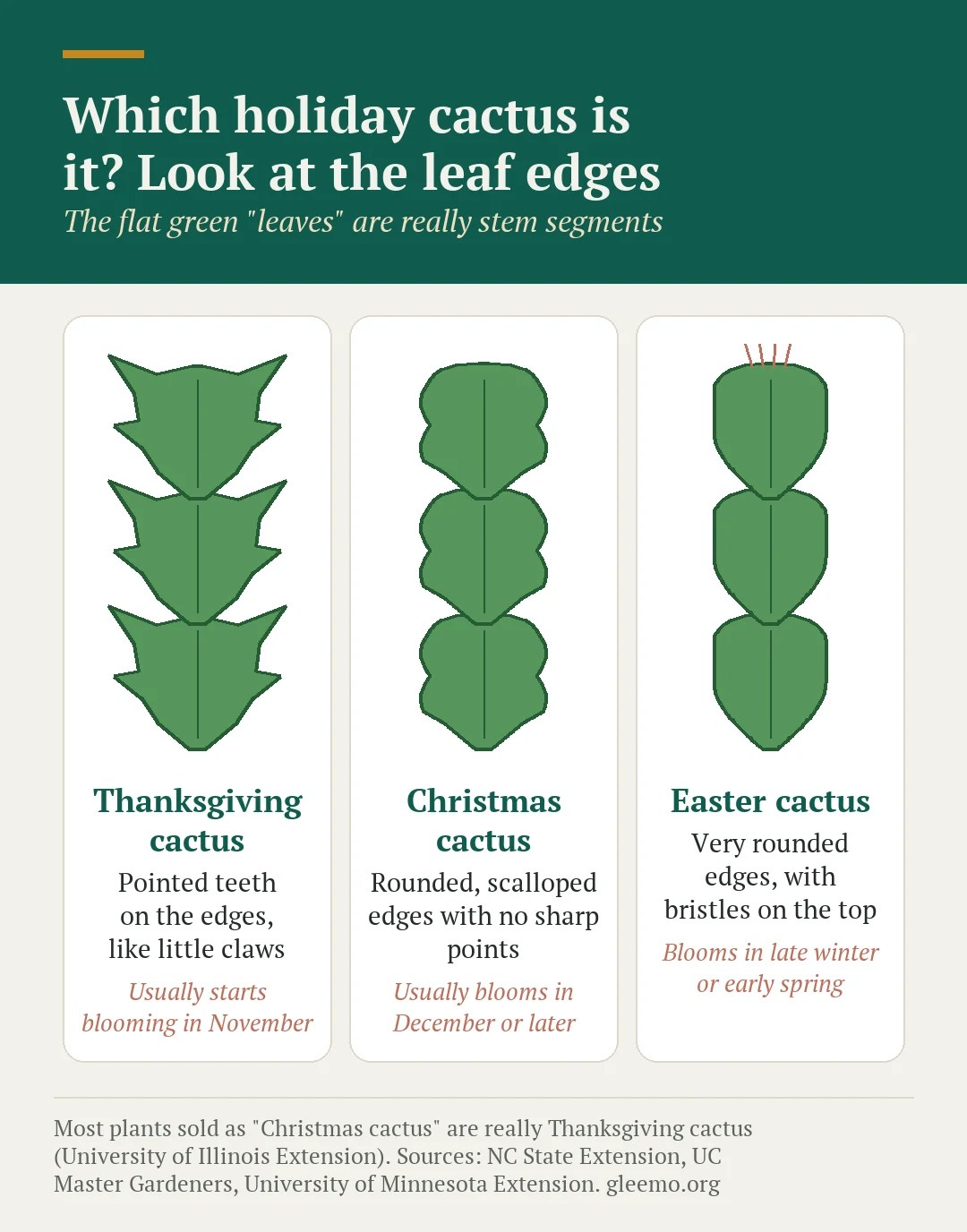
Our leaf-edge card: pointed, scalloped and very rounded.
Here is the surprise. Illinois Extension says "Most of the ‘Christmas cactuses’ sold are actually Thanksgiving cacti." Iowa State says "Most plants sold as ‘Christmas cactus’ are actually Thanksgiving cactus or hybrids." So the plant you bring home in late November is very likely a Thanksgiving cactus, and that is fine. It just means bloom may come a little earlier than the name suggests.

Photo: Sixteen Miles Out on Unsplash. Look at the stem segments: the pointed teeth mark this one as a Thanksgiving cactus, the kind most often sold as a Christmas cactus.
When each one blooms
The Thanksgiving cactus blooms earlier, and the Christmas cactus about a month later (UC ANR, University of California Agriculture and Natural Resources, and the University of Wisconsin). The Easter cactus flowers in late winter or early spring, per UMN.
Does it matter for care?
Very little. UF/IFAS lists no care differences between the Christmas and Thanksgiving cactus. The Easter cactus is on a spring schedule (UMN, Iowa State).
Amaryllis: From Bulb to Bloom, and What to Do After
Growing a bare bulb: pot, water, light, support
Iowa State says to pick a pot 1 to 2 inches wider than the bulb; UMN says about 1 inch wider. Leave the top third to one half of the bulb above the soil (UMN; Iowa State says the upper half). Start it warm, at 70 to 75 F (Iowa State). Keep the soil barely moist until growth shows, then water more. UMN says to water when the top 2 inches feel dry.
Turn the pot daily so the stalk grows straight, and stake a leaning stalk (Iowa State).
Timing, said plainly. Iowa State says to "Pot amaryllis bulbs in early to mid-November for bloom during the Christmas holidays." Dutch-grown bulbs typically bloom 6 to 8 weeks after potting, per Iowa State, and South African-grown bulbs 3 to 5 weeks. UMN says about 4 to 6 weeks. So a bulb kit potted the week of Thanksgiving will most likely bloom in January, not on Christmas. A January bloom is a fine gift if you say so when you hand it over.
The Red Lion kit from Holland Bulb Farms, listed on Amazon, contains a 24/26 cm (centimeter) Red Lion amaryllis bulb, a decorative pot, a soil disc and instructions in a gift box, and the listing says flowers open about 6 to 8 weeks after planting. A soil disc is a compressed disc you soak in water until it expands.
The Star of Holland kit from the same maker has the same box contents, and its listing says "red with a white star," so that one is here if you want the white-striped flower. A bare bulb from the garden center grows the same way, and we earn nothing from it.
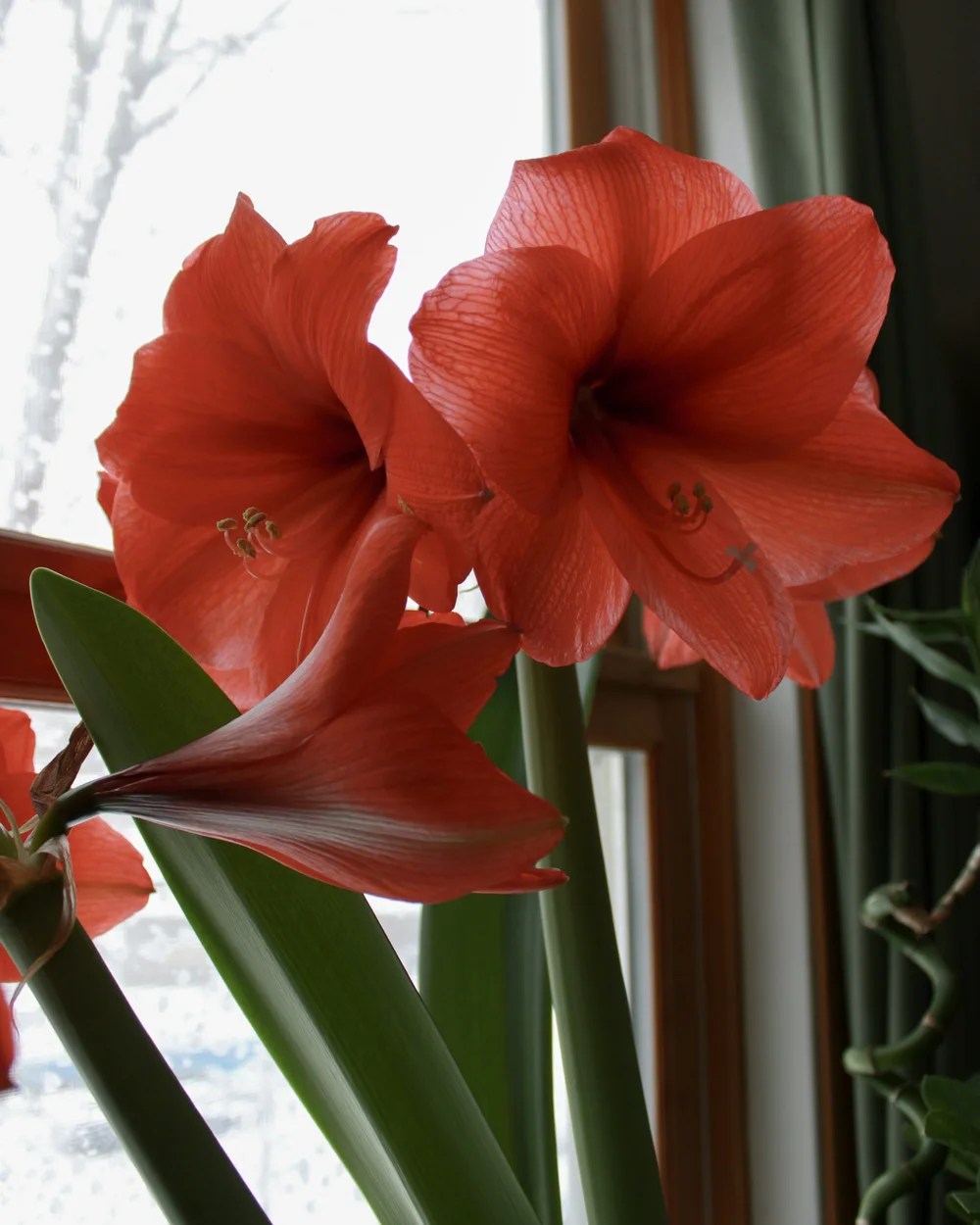
Photo: Ray T on Unsplash
Cutting back after the flowers fade
Cut off the faded flowers. For the stalk, the sources differ: UMN says leave it until it turns yellow, and Iowa State says cut it 1 to 2 inches above the bulb. Keep the leaves, and feed every 2 to 4 weeks, per Iowa State. The leaves are what recharge the bulb.
Resting the bulb and getting it to bloom next year
In late September, stop watering, move the pot somewhere cool and semi-dark and cut off brown leaves. Iowa State says 50 to 55 F for at least 8 to 10 weeks. UMN says 8 to 12 weeks in the dark. Then water to restart it.
Waxed Amaryllis: What It Is and What to Do After It Blooms
What the wax does, and what it cannot do
NC State (New Hanover County) says the wax coating "acts as a seal, trapping in the moisture and nutrients already inside the bulb." That is why a waxed bulb needs no water. You set it on a counter, and flowers open in a few weeks.
The Costa Farms waxed 2-pack on Amazon is sold by Amazon.com. The listing describes 2 red amaryllis bulbs, each sealed in red glitter wax on a wire support stand, about 5 to 7 inches tall, with no pot, soil or water needed. It says blooms come about 3 to 6 weeks after arrival, and that flowers last 2 to 3 weeks. Ordered the week of Thanksgiving, that usually means mid-December to early January.
See the waxed amaryllis on Amazon
So a waxed bulb is mostly a one-bloom gift, and a good one for someone who forgets to water.
After the bloom: three honest options
The makers and the extension pages do not agree, so here is each voice plainly:
- Jackson & Perkins (a maker) says no: "Waxed amaryllis bulbs are designed as single-use, decorative holiday gifts and do not rebloom. Because the roots have been removed and the bulb is sealed in wax, it cannot be replanted or reused."
- NC State says possible, no promise: waxed bulbs are "generally marketed as single-use decorations," and "while it is possible to rescue and regrow these bulbs with time and careful handling, there is no guarantee of success."
- Iowa State says possible, not recommended: "while it is not recommended that you save waxed bulbs, you can potentially get them to rebloom with diligent care." Some bulbs make leaves and no flowers.
So the three options are: enjoy the bloom and compost the bulb, as some people do with any amaryllis (Iowa State says some individuals discard the amaryllis after flowering); or try to save it. If you try, Iowa State and NC State say to peel the wax off carefully, check for soft or dark spots, pot it with the top above the soil, give it feed and light through spring and summer, and rest it about 8 weeks (NC State). Treat any second bloom as a bonus.
Cats and Dogs: What the ASPCA Says About These Plants
If you have a cat or dog at home, this is one of the most useful tables in the guide. These are the ASPCA’s own words, read on its plant pages on November 16, 2026. The ASPCA has no review date on these pages and can edit them, so check the page itself before you rely on it.
| Plant | ASPCA "Toxicity" line | ASPCA Clinical Signs (its words) |
|---|---|---|
| Christmas cactus | Non-Toxic to Dogs, Non-Toxic to Cats, Non-Toxic to Horses | No Clinical Signs listed |
| Poinsettia | Toxic to Dogs, Toxic to Cats, Toxic to Horses | "Irritating to the mouth and stomach, sometimes causing vomiting, but generally over-rated in toxicity." |
| Amaryllis | Toxic to Dogs, Toxic to Cats, Toxic to Horses | "Vomiting (not horses), depression, diarrhea, abdominal pain, hypersalivation, anorexia, tremors." |
Note: Source: ASPCA plant pages for the Christmas cactus, poinsettia and amaryllis, read November 16, 2026.
The ASPCA’s Christmas cactus page lists "Easter Cactus" as an additional common name. The ASPCA has no separate Thanksgiving cactus entry. The ASPCA’s amaryllis entry lists it as Toxic to Dogs, Toxic to Cats and Toxic to Horses; we claim nothing beyond that wording.
If a pet chews one, call your vet or ASPCA Poison Control at (888) 426-4435 (the ASPCA says it is open 24 hours a day, 365 days a year, and a consultation fee may apply).
Pet safety: this guide repeats the ASPCA’s own wording and nothing more. It is not veterinary advice. For a pet that has chewed a plant, call your vet or ASPCA Poison Control.
The Handed-Down Christmas Cactus: How to Share a Cutting
Many families pass a Christmas cactus down through cuttings, and it costs nothing. A cutting from your own plant, or one you ask a friend for, earns Gleemo nothing, and it is often the best gift on the list.
Taking a cutting: when and how
- Iowa State: take 2 to 5 stem segments. Cut or pinch them at a joint, and let the ends callus (dry and seal over) overnight.
- UMN: cut where two sections join.
- UC Master Gardeners: twist off the newest 3 to 5 segments.
We did not find a source that names the best season to take a cutting, so we will not name one.
Rooting it, and what goes wrong
Iowa State says to root the cuttings in damp perlite or coarse sand, with the ends about an inch deep. They "should root in about 6 to 8 weeks." Pot them into a well-drained mix once the roots are an inch long. UMN says to keep them at 70 to 80 F in bright light, moist but not wet, and to check for roots after 2 weeks.
Water works too, according to UC Master Gardeners: "Put cutting in water to cover the lowest leaf by half. Roots will form on the end resting on the bottom of the jar." Iowa State and UMN use sand or perlite, so this is a case where sources differ.
Which Christmas Plant Should You Give?
There is no clear winner here, and we would rather say that than invent one. The right plant depends on the person.
No clear winner. A cat or dog in the home: the Christmas cactus (ASPCA: Non-Toxic). A person who forgets to water: a waxed amaryllis or a cactus. A person who likes a project: a bulb kit. Color on Christmas Day itself: a plant already in bud or color.
| Plant | Cats and dogs (ASPCA words) | Forgives a missed watering | Work after the holidays | Will it bloom again | The catch |
|---|---|---|---|---|---|
| Christmas cactus | Non-Toxic | Yes: let it dry between waterings | Keeps going | Possible, with dark or cool nights | Probably a Thanksgiving cactus; check for buds |
| Poinsettia | Toxic | No: least forgiving | None if you let it go | Hard (UMN) | Cold ride home can damage it |
| Amaryllis bulb kit | Toxic | Water when the top 2 inches feel dry (UMN) | Rest and restart | Possible | Likely blooms in January |
| Waxed amaryllis | Toxic (amaryllis entry) | Yes: no water | Discard or try to save | Sources disagree | Mostly a one-bloom gift |
Note: The ASPCA words are from aspca.org, read November 16, 2026. The other columns are our read of the extension sources above, not a published comparison.
For a host, a neighbor, or mom or grandma
For a host, a poinsettia is a classic; if the host has a cat or dog, check the ASPCA table first. For a neighbor or mom or grandma who may forget a watering, the cactus or a waxed bulb is the forgiving choice. For anyone who likes watching something grow, a bulb kit. More ideas: our Christmas gift ideas for mom and dad and puzzle gifts for grandma and mom.
A plant that forgives a missed watering, and one that does not
The cactus and the waxed bulb forgive a missed watering. The poinsettia does not: Iowa State says too much and too little water both drop leaves.
A waxed amaryllis kit in a box
For color with no work, the waxed 2-pack above fits. For a project, the bulb kit fits, and "blooms in January" is a good line to write on the card. For color on Christmas Day itself, buy a plant already in bud or color.
Mistakes to Avoid
- Letting a poinsettia sit in water in its foil cover (Iowa State).
- Putting it by drafts, heat ducts or cold glass (UMN, USBG, Iowa State).
- Leaving it in a cold car.
- Moving a cactus while it is in bud (Iowa State).
- Leaving a light on near the cactus in the fall (Iowa State).
- Promising a rebloom. Neither the poinsettia nor the waxed bulb comes with one.
Frequently Asked Questions
What two things trigger a Christmas cactus to bloom?
Long, uninterrupted dark nights and cool nights, per Purdue, which says either one can do it. UMN gives its numbers in the bloom section above.
Why is my Christmas cactus not blooming?
Iowa State’s FAQ lists light at night in the fall, temperatures above 70 F, and a plant that was moved or sat in a draft while in bud.
How do I save my poinsettia for next year?
Iowa State: cut back in March, outdoors in late May, nightly darkness from early October until the color shows. UMN and USU differ on dates and hours. UMN says it is hard, and composting it is fine.
Why are leaves dropping off my poinsettia?
Most often watering, per Iowa State: too much or too little. Warm dry air from vents, drafts and door swings can do it too.
What do you do with amaryllis bulbs after they bloom?
Cut the faded flowers, keep the leaves and feed every 2 to 4 weeks (Iowa State). Rest the bulb from late September for 8 to 12 weeks, depending on the source, then water again.
What do you do with a waxed amaryllis after it blooms?
Sources disagree. Jackson & Perkins says it cannot be reused; NC State says possible with no guarantee; Iowa State says not recommended but possible with diligent care.
What happens if a cat eats a poinsettia?
The ASPCA lists the poinsettia as Toxic to Dogs and Toxic to Cats, and its Clinical Signs line reads "Irritating to the mouth and stomach, sometimes causing vomiting, but generally over-rated in toxicity." Call your vet or ASPCA Poison Control at (888) 426-4435.
What is the best plant to give as a Christmas gift?
There is no clear winner. Pick by person; see the gift table above.
The Bottom Line
Pick a plant with good color and a sleeve, put it in bright light away from drafts, and water only when the soil asks. The cactus is the keeper, the amaryllis is a project, and the poinsettia is a holiday guest you can enjoy and let go. If you are heading out to see lights, our guide to a holiday train ride is a nice day out. And if a winter hobby sounds good once the decorations come down, try crochet for beginners.
Setting out a Christmas village this year too? Our guide to setting up a Christmas village covers the base, the lights and cords, storage, and how to check what a piece is worth.
