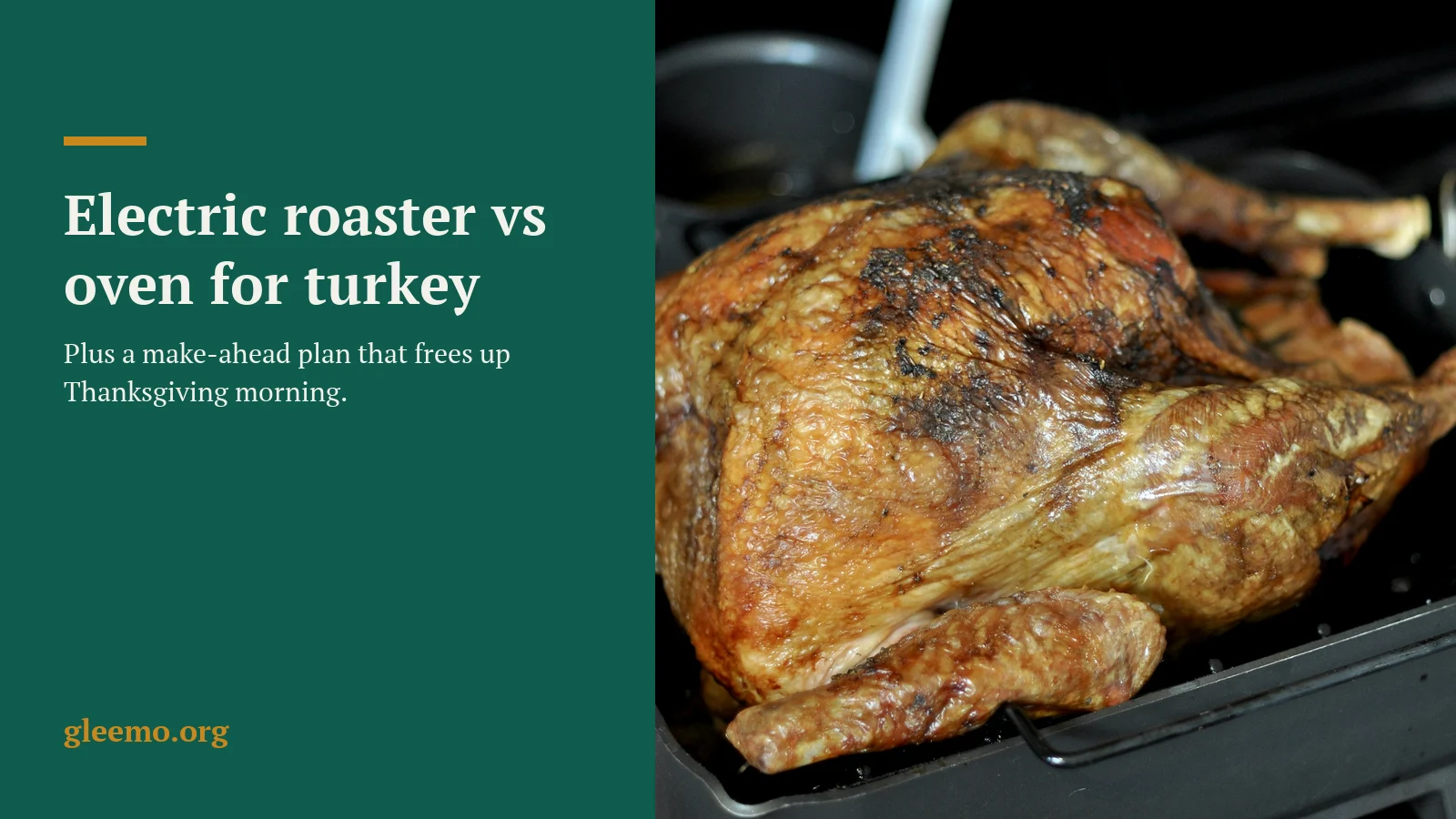
Electric roaster vs oven for turkey comes down to space, not a proven winner. USDA calls a roaster "an extra oven," and that is its case: your real oven stays free for sides and pies. We found no independent test showing either cooks a better turkey, and the makers disagree on time, size and browning. Pick by counter space and what you already own, cook to 165 degrees F on a food thermometer, and use the plan below with either one.
This guide is for the host who has done this for years and wants the oven back, and for the son or daughter helping Mom or Dad host. Thanksgiving is Thursday, Nov 26, 2026.
Facts as of October 20, 2026. We read the makers’ manuals and USDA’s pages; we did not cook-test any roaster.
Some links in this guide are affiliate links. If you buy through one, we may earn a small commission at no extra cost to you. It never changes what we recommend. As an Amazon Associate I earn from qualifying purchases. We earn nothing if you cook in the oven you already own, borrow a roaster, or read a maker’s own page. They are in this guide because they may be the better choice for you. Amazon sets prices and changes them often, so we do not print them here.
Food-safety facts here come from the USDA’s Food Safety and Inspection Service. Always follow the manual that came with your appliance. Questions about your turkey? The USDA Meat and Poultry Hotline is 1-888-MPHotline (1-888-674-6854), open year-round Monday through Friday, 10 a.m. to 6 p.m. Eastern (hotline page). Check fsis.usda.gov for any holiday-week hours.
Electric Roaster vs Oven for Turkey: The Real Difference Is a Free Oven
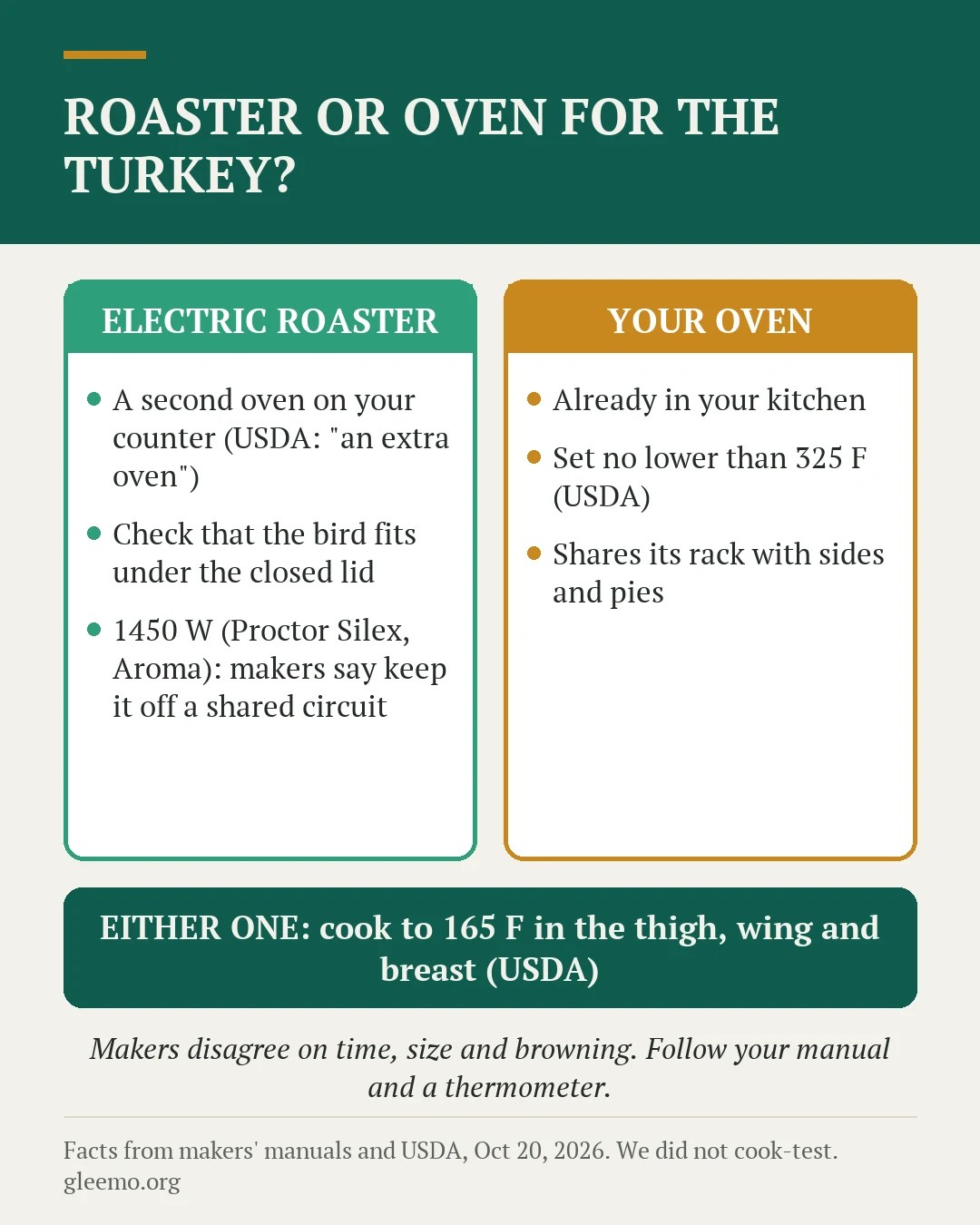
USDA says a roaster "serves as an extra oven for cooking a turkey or large roast," and Proctor Silex’s page promises "Doubles your oven space." Neither promises a better result, so a roaster earns its counter space only when the oven is the bottleneck: a big bird, a pie, and sides that all want the same rack (our note). For a small table, USDA says to allow 1 pound of turkey per person, so a turkey breast in your own oven may do. Try borrowing a roaster from a relative, neighbor or church kitchen first.
| What you are deciding | Electric roaster | Your oven (USDA) |
|---|---|---|
| Oven space | A second oven on the counter | Shared with sides and pies (our note) |
| Turkey size | USDA’s roaster row: 8 to 24 lb. Makers claim different limits | USDA’s oven table: up to 24 lb |
| Time, 20-lb bird | Makers’ charts: 3 hours to 6 hours 40 minutes. USDA: "generally" the same as an oven | 4 1/4 to 5 hours at 325 F |
| Browning | Makers disagree | No independent test of either found |
| Counter and outlet | Counter space; 1450 W; Proctor Silex and Aroma say no shared circuit | None needed (our note) |
Note: "Our note" means a practical note, not a maker or USDA statement.
What Each Maker Says: Size, Time, Water, Browning and Warranty
The two roasters we link, in their makers’ words as of October 20, 2026.
| What it covers | Proctor Silex 18 qt, 32211 | Aroma 22 qt, ART-832ST |
|---|---|---|
| Biggest turkey | "holds a 24 lb. turkey"; manual chart goes to 28 lb | "hold and roast a 26-lb. turkey" |
| Temperature and time, 20 lb | 125-450 F. At 325 F: 3 to 3 1/2 hours; thermometer column says 180 F | 150-450 F. At 350-400 F: 13 to 16 minutes per pound |
| Water | No water step to roast | No water step; never add water "without the cooking pan in place" |
| Rack and lid | Lift-out rack; domed, self-basting lid | Removable rack; self-basting lid |
| Browning | Says nothing | Says nothing for turkey |
| Power and outlet | 1450 W, 120 V. "do not use another high-wattage appliance on the same circuit" | 1450 W, 120 V. "separate electric circuit"; no extension cord |
| Warranty | 3 years on the product page, 1 year in the manual: a conflict | 1 year |
The size numbers do not line up. Hamilton Beach’s 22 qt page says it "holds a 28 lb. turkey," but its category page says 22 qt roasters take "turkeys up to 24 lbs." and 18 qt ones "turkeys up to 18 lbs." Proctor Silex is a Hamilton Beach Brands brand; Nesco’s 18 qt says "up to 22 pounds." We cannot settle it, so measure your bird against the closed lid.
Four Questions About Roaster Turkeys, Answered From the Manuals
How long does it take to cook a 20-pound turkey in an electric roaster?
Published numbers span hours:
- Proctor Silex 32211 (Hamilton Beach: same chart): 3 to 3 1/2 hours at 325 F.
- Aroma: 4 hours 20 minutes to 5 hours 20 minutes (13 to 16 minutes per pound).
- Nesco: 5 hours to 6 hours 40 minutes (15 to 20 minutes per pound at 400 F).
- USDA, regular oven: 4 1/4 to 5 hours at 325 F, approximate.
Only a thermometer settles it. USDA says a whole turkey is safe at 165 degrees F in the innermost part of the thigh and wing and the thickest part of the breast, probe off the bone. Some charts list 180 degrees F; USDA says "for reasons of personal preference, consumers may choose to cook turkey to higher temperatures."
Do I put water in the bottom of an electric roaster for turkey?
Check your own manual. The current Proctor Silex 32211, Hamilton Beach 22 qt and Aroma manuals give no instruction to add water to roast a turkey; older Hamilton Beach manuals for other models said 1/2 cup. USDA’s advice is about the rack: keep the turkey "raised out of the juices that collect in the bottom of the oven liner."
Will a turkey brown in an electric roaster?
The makers disagree. Oster’s web page says "Your Turkey Will Brown," with basting. Hamilton Beach’s Test Kitchen blog says "very moist, but less brown than a traditionally roasted turkey." Nesco offers browning-sauce tips and a 400 degrees F method. The Proctor Silex and Aroma manuals say nothing. We found no independent test.
Does a turkey cook quicker in a roaster oven?
Some makers say yes: Oster’s page claims "30 percent less time," Aroma’s says it "cooks faster than a conventional oven," and a Hamilton Beach blog says it "cooks a turkey in less time than a regular oven." None cites a test, and USDA says times are "generally" the same. For 20 pounds, Aroma’s and Nesco’s charts are not shorter than USDA’s oven table; Proctor Silex’s is. So "faster" is a maker claim.
Which Roasters We Link, and Why There Is No Clear Winner
Top pick on availability: Proctor Silex 18 qt, model 32211. On October 20 both its maker and Amazon showed it for sale, and the maker says it holds a 24 lb. turkey, the top of USDA’s 8 to 24 lb roaster range. There is no clear winner on how these roasters cook, and we did not test them.
Proctor Silex 32211: the top pick
Its warranty is a conflict: 3 years on the product page, one (1) year in the Use and Care manual, and we cannot say which is right. Stock can change, so check the page you land on.
Check the current price of the Proctor Silex 32211 on Amazon
Aroma ART-832ST: the larger option
Aroma’s own store showed it out of stock on October 20 while Amazon showed it in stock. Its Keep Warm setting has no stated temperature, so use a thermometer; USDA’s hot-holding number is 140 degrees F or warmer. Its manual bars oven bags and metal foil.
Check the current price of the Aroma 22 qt on Amazon
We do not link Hamilton Beach’s 22 qt roaster: the maker’s own store showed its 22 qt roasters out of stock on October 20, and the Amazon listing we checked was a third-party seller’s. We also skip Nesco and Oster; we could not confirm a buyable Amazon listing for either. Ordering one? Here is how to keep a delivered box from sitting on the porch.
A food thermometer, for any oven
USDA’s rule is a temperature, not a clock. No thermometer yet? The ThermoWorks ThermoPop 2 instant-read thermometer was in stock on Amazon on October 20.
Check the current price of the ThermoPop 2 on Amazon
A slow cooker, for keeping food warm only
USDA says "Reheating leftovers in a slow cooker is not recommended." Heat food to 165 degrees F on the stove, in a microwave or in the oven first, then hold it at 140 degrees F or higher in a preheated slow cooker. The Hamilton Beach 7 quart slow cooker, model 33174 (also on Amazon) lists Keep Warm.
The One-Oven Make-Ahead Plan, Two Weeks Out to Leftovers
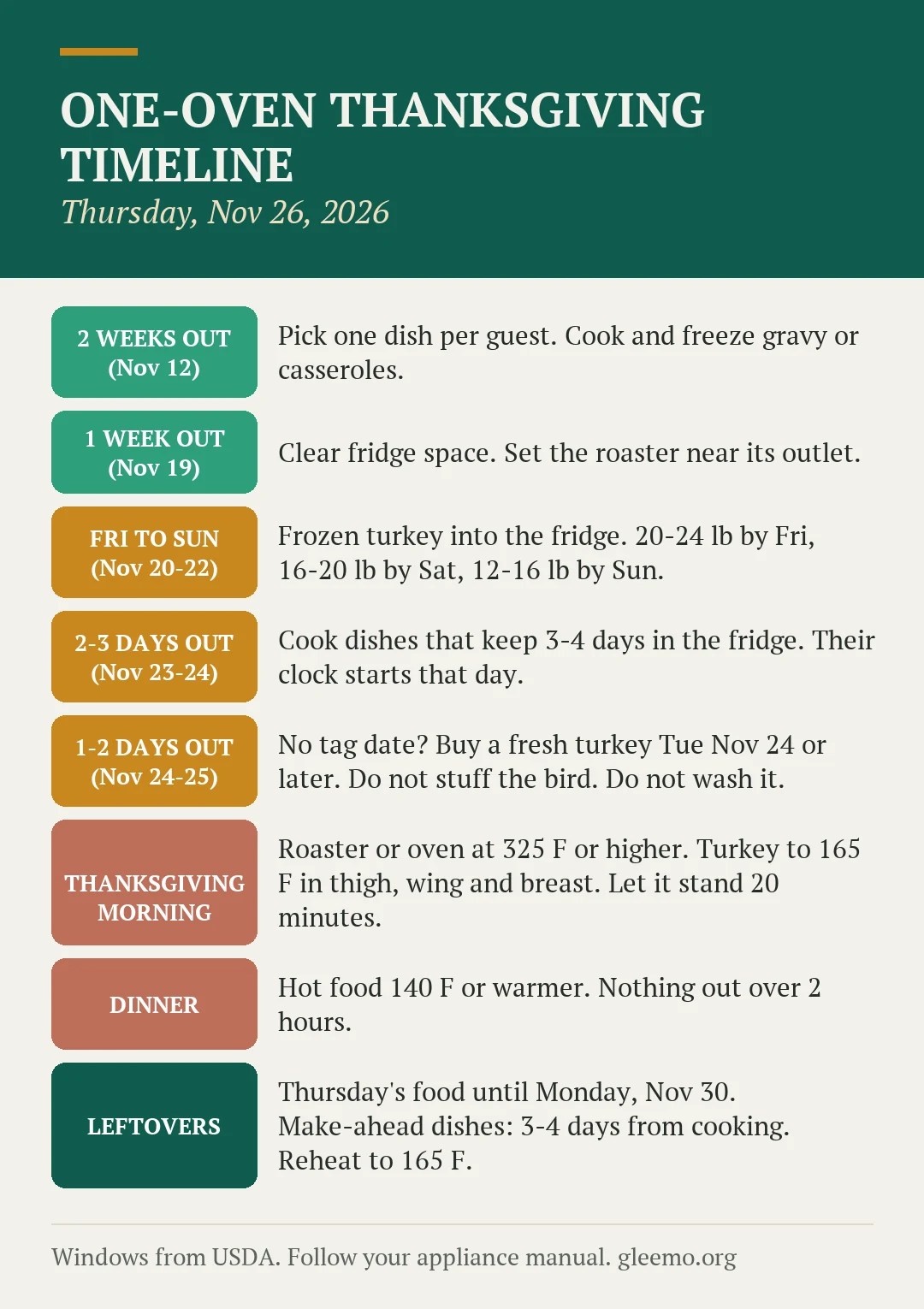
Each row uses a USDA window; where USDA gives none, it says "practical note" and gives no number. Who: You is the host, Helper a son, daughter or friend, Guest whoever brings a dish. Helping a parent host? The Helper rows are yours.
| When | What happens | Who | Basis |
|---|---|---|---|
| 2 weeks out (Thu Nov 12) | One dish per guest; ask if it needs the oven. Run the roaster’s first-use step (Aroma: 400 F for 30 minutes or until smoke and odors are gone). Cook and freeze gravy, casseroles, pumpkin or pecan pie | You, Guest | Practical note; Aroma manual; USDA freezer (quality): casseroles, gravy 2-3 months, pie 1-2 |
| 1 week out (Thu Nov 19) | Clear fridge space. Set the roaster 4+ inches from walls, off a shared circuit | You or Helper | Practical note; makers’ manuals |
| Fri Nov 20 to Sun Nov 22 | Frozen turkey into the fridge: 20-24 lb by Fri, 16-20 lb by Sat, 12-16 lb by Sun | You or Helper | USDA |
| 2-3 days out (Mon Nov 23 to Tue Nov 24) | Cook what can wait chilled: casseroles, gravy, soups, mashed potatoes, vegetables, pumpkin or pecan pie. Their 3-4 day fridge clock starts the day you cook them | Guest or You | USDA: cooked food keeps 3-4 days (general rule) |
| 2-3 days out | Stuffing: chill dry and wet ingredients separately; mix just before cooking. Cranberry sauce, fruit pies, pie dough, rolls: make when it suits you | You, Guest | USDA: do not prepare stuffing ahead. Practical note – no official window for the rest |
| 1-2 days out (Tue Nov 24 to Wed Nov 25) | Buy a fresh turkey (no tag date: Tue Nov 24 at the earliest). Do not stuff the bird the night before; safest not to wash it | You | USDA |
| Thanksgiving morning (Thu Nov 26) | Preheat roaster or oven to 325 F or higher. Turkey on the rack (roaster: lid on) to 165 F in thigh, wing and breast. Stand 20 minutes. Sides use the oven while the bird roasts (roaster) or stands (oven) | You, Helper | USDA; sides timing is a practical note |
| Thanksgiving morning | Reheat make-ahead dishes to 165 F, gravy to a rolling boil | Helper | USDA |
| Dinner | Hot food 140 F or warmer, cold food 40 F or below. Discard turkey, stuffing and gravy left out over 2 hours (1 hour above 90 F) | Everyone | USDA |
| After dinner | Refrigerate within 2 hours. Turkey and dishes cooked Thursday: up to four days, until Monday, Nov 30. Make-ahead dishes: 3-4 days from the day you cooked them, so they run out sooner (freeze what you will not eat in time). Freezer: 2-6 months for quality | Helper and Guests | USDA |
Note: USDA’s freezer times are for quality; food kept at 0 F stays safe.
USDA Thawing Times for a Thursday, Nov 26 Dinner
USDA’s three safe thawing methods are the refrigerator, cold water and the microwave. In the refrigerator, "allow approximately 24 hours for each 4 to 5 pounds" at 40 degrees F or below.
| Turkey weight | Refrigerator (USDA) | Put it in the fridge by | Cold water (USDA) |
|---|---|---|---|
| 12 to 16 lb | 3 to 4 days | Sun Nov 22 | 6 to 8 hours |
| 16 to 20 lb | 4 to 5 days | Sat Nov 21 | 8 to 10 hours |
| 20 to 24 lb | 5 to 6 days | Fri Nov 20 | 10 to 12 hours |
Note: A thawed turkey can stay in the refrigerator 1 to 2 days. Cold water: change the water every 30 minutes and cook right after. Never thaw on the counter. A roaster’s Defrost setting is not a USDA method. Start dates are our count back from Nov 26.
Frequently Asked Questions
What size electric roaster for a 20-pound turkey?
Makers claim 22 to 26 pounds for the models above; Hamilton Beach’s pages conflict. Measure your bird against the closed lid.
Can you cook a frozen turkey in an electric roaster?
Check your manual. USDA says roasting from frozen is safe but takes at least 50 percent longer. We do not suggest the Defrost setting as a thaw.
Can you cook a turkey overnight in an electric roaster?
We found nothing that supports it. USDA says to preheat a roaster to at least 325 degrees F; no maker chart we read goes lower.
How do you keep Thanksgiving food warm without the oven?
USDA says keep hot food at 140 degrees F or warmer, in chafing dishes, slow cookers or warming trays. Heat it to 165 degrees F elsewhere first.
How far ahead can you make Thanksgiving side dishes?
USDA: cooked casseroles and gravy keep 3-4 days refrigerated, counted from the day you cook them, or 2-3 months frozen for quality. Stuffing should not be prepared ahead.
Where to Start This Week
Pick the dishes, then set your thaw date from the table above. The plan works with or without a roaster. USDA’s Thanksgiving guide was last updated Nov 25, 2025, so check fsis.usda.gov for a newer one. More clear, honest guides for your next chapter are at gleemo.org.
