
Should I get a dog at 65? Plenty of people in their sixties ask it, and their grown children ask it too, usually a little more nervously.
Maybe you are 66, you want a dog, and your kids are worried. Maybe you are the son or daughter, and Mom keeps bringing one up. Either way, it is a planning question more than an age question. Settle three things first: where to find a dog that fits, what five years really cost, and who takes the dog if you can’t. The same plan works at 70.
Some links in this guide are affiliate links. If you buy through one, we may earn a small commission at no extra cost to you. It never changes what we recommend. As an Amazon Associate I earn from qualifying purchases.
Should I Get a Dog at 65? The Short Answer: Plan It, Then Say Yes
- Look at adult and older dogs first. Some shelters match older adopters with older pets and waive the fee.
- Ask about a senior-for-senior program. Adopter ages in our table run from 55 to 65.
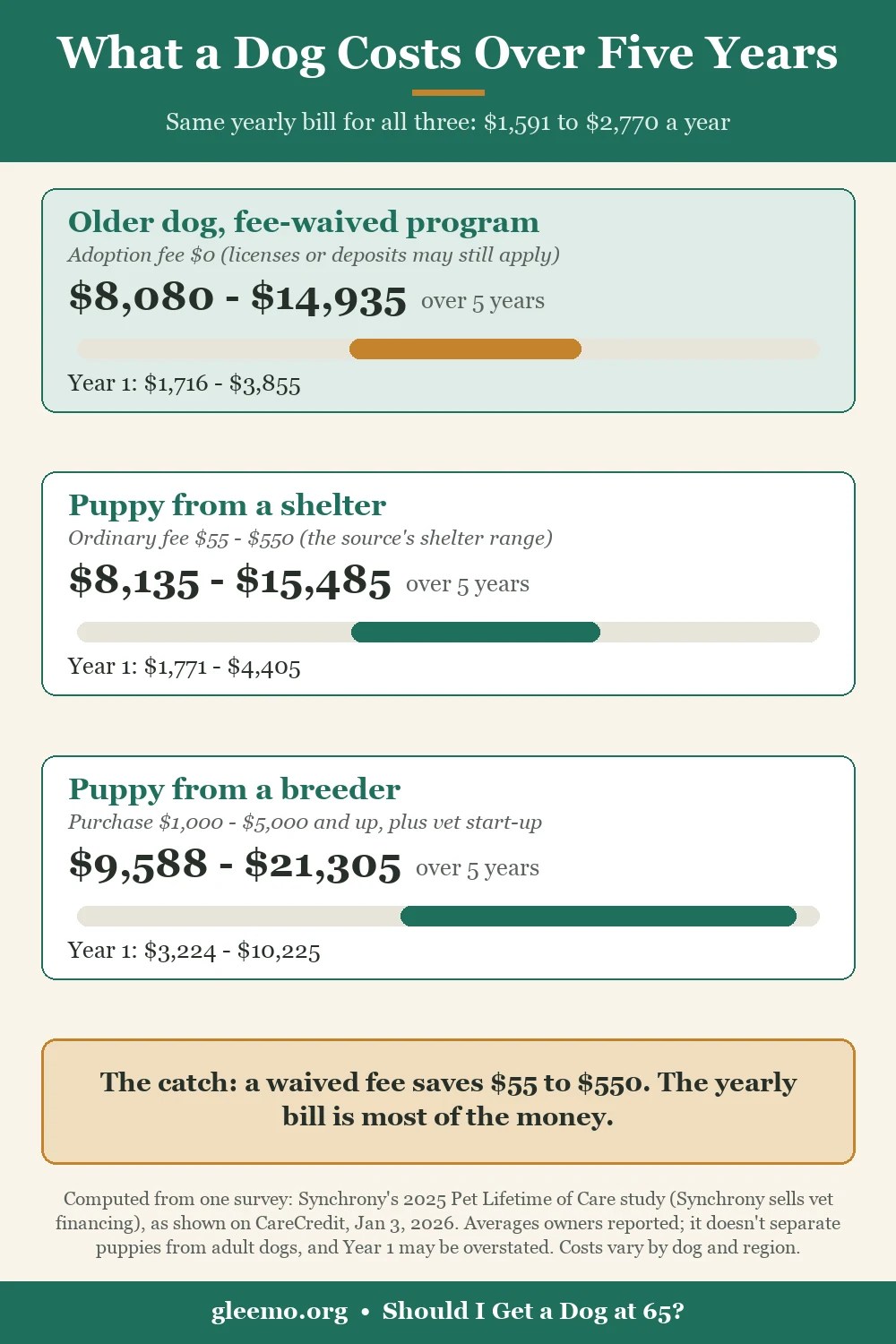
- Budget for five years, not adoption day. One survey-based estimate puts five years at $8,080 to $14,935 for an older dog from a fee-waived program.
- Write down who takes the dog. One name for a short stay, one for good.
- Foster first if you’re unsure. Some shelters let you try a dog, then adopt.
Gleemo isn’t a vet or a lawyer. Costs vary by dog and region, and a pet trust is a question for an attorney.
Senior-for-Senior Dog Adoption: Who Waives the Fee
Many shelters run a "seniors for seniors" program: an older adopter, an older pet, and a lower fee or none. We read 14 programs’ own pages. Ten waive the fee outright for qualifying older adopters, one waives it only when a senior adopts a senior pet, and three take part of it off. Here are ten, sorted by the adopter age they ask for.
| Program | Adopter age | Pet age | Fee | Fine print |
|---|---|---|---|---|
| Salt Lake County Animal Services, UT | over 55 | over 5 | Waived; microchip, sterilization and vaccines included | Proof of age. Excludes puppies. |
| Porter County Animal Shelter, Valparaiso IN | 55+ | typically over 7 | Waived | Approved application needed. |
| Pasadena Humane, CA | 60+ | 5 and up | "Free of charge," funded by Pets for the Elderly | – |
| Animal Defense League of Texas, San Antonio | 60+ | over 8 | "Fee-waived adoptions" (no amount on page) | – |
| NYC Animal Care Centers, NY | 60+ | at least 6 | Waived | NYC dog license $8.50 to $34. |
| Lollypop Farm, Fairport NY | 60+ | 6+ | Waived | A separate free week ended May 24, 2026. |
| Animal Welfare Association, Voorhees NJ | 60+ | Cats 6+; small dogs 10+; dogs 20+ lb 7+ | Waived on listed animals | Camden County residents only. |
| Animal Rescue League of Iowa | 60+ | 6 months+ | $50 off the fee (Pets for the Elderly) | "As funds are available." |
| Muttville, San Francisco CA | 62+ | not stated on page | $250 fee waived; welcome kit | – |
| Norfolk Animal Care Center, VA | 65 and older | over 7 | $35 for any pet if you are 65+ (regular $75); waived if a senior adopts a senior pet | – |
Note: We read each program’s own page on October 7, 2026. None of those pages shows a date, so call the shelter before you go.
The rules do not line up. Adopter ages run from 55 to 65. Pet-age rules run from 5 to over 8, and 10 for small dogs at one program. A single page cannot tell you which program fits you.
A waived adoption fee is not a free dog. Licenses, deposits and the dog’s yearly costs still apply. Some offers are limited by funding, by residency (Camden County, NJ) or by exclusions (Salt Lake County excludes puppies). Some shelters run seasonal offers, too, so ask.
Pets for the Elderly Foundation: The National Option
Pets for the Elderly Foundation helps pay adoption fees at participating shelters for adopters age 60 and over who take a dog or cat. Its participating shelters page lists more than 50 shelters in more than 30 states. Its own site names no dollar amount, because each shelter sets it: $50 off in Iowa, $75 off at the Baltimore Humane Society, "free of charge" in Pasadena.
How to Ask Your Own Shelter
Your local shelter may run a program that is not in our table. Ask:
- Do you have a senior-for-senior program?
- What ages does it cover, for me and for the dog?
- What does the waiver cover, and what still costs money (a license, a deposit)?
- Can I foster first?
- Will you take the dog back if I can’t keep it?

Not Sure Yet? Foster First
Fostering lets you try a dog before you commit. Salt Lake County Animal Services says it provides "a crate (for dogs), food, medicine if needed, vet care for foster pet(s), a collar, and leash". A foster who wants to adopt follows its standard adoption process, and its page doesn’t promise a waived fee. Lollypop Farm provides "all of the necessary supplies" and lets fosters adopt their foster animal. Ask whether a waiver carries over.
Want to start smaller? Muttville’s San Francisco headquarters asks volunteers to help with "walking the mutts," at least three hours a week for at least six months.
What a Dog Really Costs Over Five Years: The Fee Is the Small Part
This model uses one source: Synchrony’s 2025 Pet Lifetime of Care study of 4,861 pet owners (surveyed January 31 to February 22, 2025; released June 2, 2025), as shown in CareCredit’s article dated January 3, 2026. That article says dog owners spend $1,591 to $2,770 a year. Costs are as of October 2026 and vary by dog and region.
Read it with care. Synchrony sells vet financing through CareCredit. The figures are averages of what surveyed owners said they spent. The study does not separate puppies from adult dogs, so the yearly range is the same for both. Year 1 may be overstated, because the source does not say whether its yearly figure includes setup.
| Cost | Older dog, fee-waived program | Puppy, shelter (ordinary fee) | Puppy, reputable breeder |
|---|---|---|---|
| Adoption or purchase fee | $0 (licenses or deposits may still apply) | $55 – $550 | $1,000 – $5,000 and up |
| Start-up supplies | $125 – $1,085 | $125 – $1,085 | $125 – $1,085 |
| Vet start-up items | Usually in the program fee | Usually in the fee | $508 – $1,370 extra |
| Year 1 total | $1,716 – $3,855 | $1,771 – $4,405 | $3,224 – $10,225 |
| Years 2-5 (4 years) | $6,364 – $11,080 | $6,364 – $11,080 | $6,364 – $11,080 |
| 5-year total | $8,080 – $14,935 | $8,135 – $15,485 | $9,588 – $21,305 |
Note: Synchrony 2025 via CareCredit (Jan 3, 2026). Yearly spending is $1,591 – $2,770 for every dog. Year 1 may be overstated. Costs vary by dog and region.
The catch: the waiver is real, but small. It removes the adoption fee, $55 to $550 in the source’s shelter range. On Lollypop Farm’s own fee page, a dog 6 or older is $125 and a dog 7 months or under is $450, a $325 gap. The yearly bill is most of the money. If you rent, the source also lists a pet deposit of up to $500 and pet rent of $25 to $75 a month.
Older Dog or Puppy: Where the Money Differs
In this source, the yearly bill is the same for every dog. Only the start differs, as the table shows. A puppy is not off the table. It just costs more at the start. CareCredit also says that as a dog ages or becomes ill, "they’ll need to see the vet for checkups more often and may also require medication or other types of treatment." It gives no dollar figure.
Is Pet Insurance Worth It for an Older Dog?
As of October 7, 2026, the insurers’ own pages say:
- Embrace: pets 15 years or older, too old for full coverage, can get an accident-only policy. "No pet insurance company covers pre-existing conditions."
- ASPCA Pet Health Insurance: "no upper-age restrictions for enrolling," and premiums "may increase or decrease due to the age of your pet." Pre-existing conditions are usually not covered.
- Nationwide: new Illness enrollment is "only available for dogs and cats 8 years and younger," and new Major Medical enrollment is "9 years and younger." "Pre-existing conditions are not covered."
The trade-off: age limits differ, and all three exclude conditions the dog already has. A newly adopted older dog may have exclusions from day one. This is a comparison, not a recommendation. Get a quote for your dog’s age and read the exclusions before you choose between a policy and a savings cushion.
Your First Week: Free Options Before You Buy Anything
Humane World for Animals lists the basics for a new dog: "a flat-buckle or martingale collar and identification tag, a harness and a 6-foot nylon leash, food and water bowls, a bed – and toys!" It says to take your new dog to the vet within a week.
Start with what costs nothing: ask your shelter what goes home with the dog. Muttville’s welcome kit for adopters 62+ includes "your dog’s harness and collar, a leash, dog bowls, a starter supply of food and medication, a doggy bed".
If you still need gear, buy after you meet the dog, because sizes depend on the dog. Check the current price on Amazon.
- Bed: The Furhaven memory foam dog bed in Medium is made for dogs up to 35 lbs and has a removable, washable cover. Its listing says it is not suitable for dogs that chew destructively, and its 90-day limited coverage against defects may not apply if you buy from an unauthorized reseller.
- Harness: The rabbitgoo no-pull dog harness comes in sizes. Its listing says to measure your dog’s neck and check girth carefully. It is a harness only, so a leash is separate.
A dog also means walks, so comfortable shoes matter. Our honest guide to walking shoes can help.
Who Takes the Dog? Write the Plan Before You Bring One Home
Plan for two situations, name a person for each, and write both on one card.
For a week: a hospital stay or a trip. The ASPCA says the person who steps in during an emergency "does not have to be the person who would take your animals permanently." A neighbor or friend can often check on the dog during a hospital stay. Write down:
- your backup person’s name and number
- where the food and medicines are
- who has a key
- the vet’s number
For good: if you can’t care for the dog. Name a caregiver who has agreed. The ASPCA’s advice: "Don’t assume! Check in with your chosen caregivers periodically to ensure they are still willing and able." Ask your shelter about its return policy. Muttville is one written example: it "remains committed to the dogs for the remainder of their lives and will accept dogs back should it not work out." Ask yours.
A pet trust. The ASPCA’s pet trust primer calls it "a legally sanctioned arrangement providing for the care and maintenance of one or more companion animals" if the owner is disabled or dies. A trustee holds money for the caregiver. The ASPCA also says an informal arrangement "is enough for most pet parents." A pet trust is a question for an attorney.
A paid sitter or boarding is the fallback, after family and neighbors.

For Sons and Daughters: Should Mom Get a Dog?
You can help without taking over.
- Let her choose the dog. Never a surprise dog. The ASPCA recommends giving a pet as a gift "only to people who have expressed a sustained interest in owning one."
- Give an honest gift. The adoption fee where there is one, first-week supplies, or money set aside for a sitter.
- Offer to be the named backup on her plan card.
- Visit the shelter together, or foster together first.
Frequently Asked Questions
Am I too old to get a dog at 70?
Age alone doesn’t answer it. A plan does: a dog that fits, a five-year budget and a named backup. The programs in our table set minimum adopter ages from 55 to 65.
Do shelters have programs for older adopters?
Yes. Of 14 programs we read, 10 waive the fee outright for qualifying older adopters. Rules differ, so use the table and call first.
Is a puppy a bad idea at 65?
Not by itself. In our cost source the yearly bill is the same for puppies and adult dogs, and a puppy costs more at the start. One program in our table excludes puppies, so ask.
What happens to my dog if I go into assisted living?
Name a caregiver who has agreed, fill in the plan card, and ask any community you are considering about its pet rules early. A pet trust is a question for an attorney.
When is Adopt a Senior Pet Month?
November, which the ASPCA promotes. It is an awareness month, not a government holiday.
This week, call your local shelter and ask one question: do you have a senior-for-senior program, and can I foster first? Then print the plan card above and write one name on it before you bring a dog home. More honest, jargon-free guides for the next chapter are waiting at gleemo.org.
Photo: Ron Lach / Pexels
