What is the best telescope for seniors? It comes down to one question: do you want to look through an eyepiece, or watch the sky on a screen? Your glasses, your back and your budget follow from that answer.
Maybe you are 64, you wear glasses, and you would like to see Saturn for yourself. Maybe you are the son or daughter, and Dad has talked about the stars since he retired. We start with the free ways to try before you buy, then compare binoculars, a tabletop Dobsonian (a simple telescope you aim by hand) and a smart telescope.
Solar safety first. Never point any telescope or binoculars at the sun without a special-purpose solar filter fitted over the front. NASA says looking at the Sun through binoculars or a telescope without one "will instantly cause severe eye injury," and the American Astronomical Society’s Solar Eclipse Task Force says the filter must be attached to the front. Both allow one exception, the total phase of a total eclipse, and our "never" is the stricter rule. NASA also says: "Do NOT use eclipse glasses or handheld viewers with cameras, binoculars, or telescopes."
Some links in this guide are affiliate links. If you buy through one, we may earn a small commission at no extra cost to you. It never changes what we recommend. As an Amazon Associate I earn from qualifying purchases.
The Short Answer: Pick How You Want to Look, Then What You Can Carry
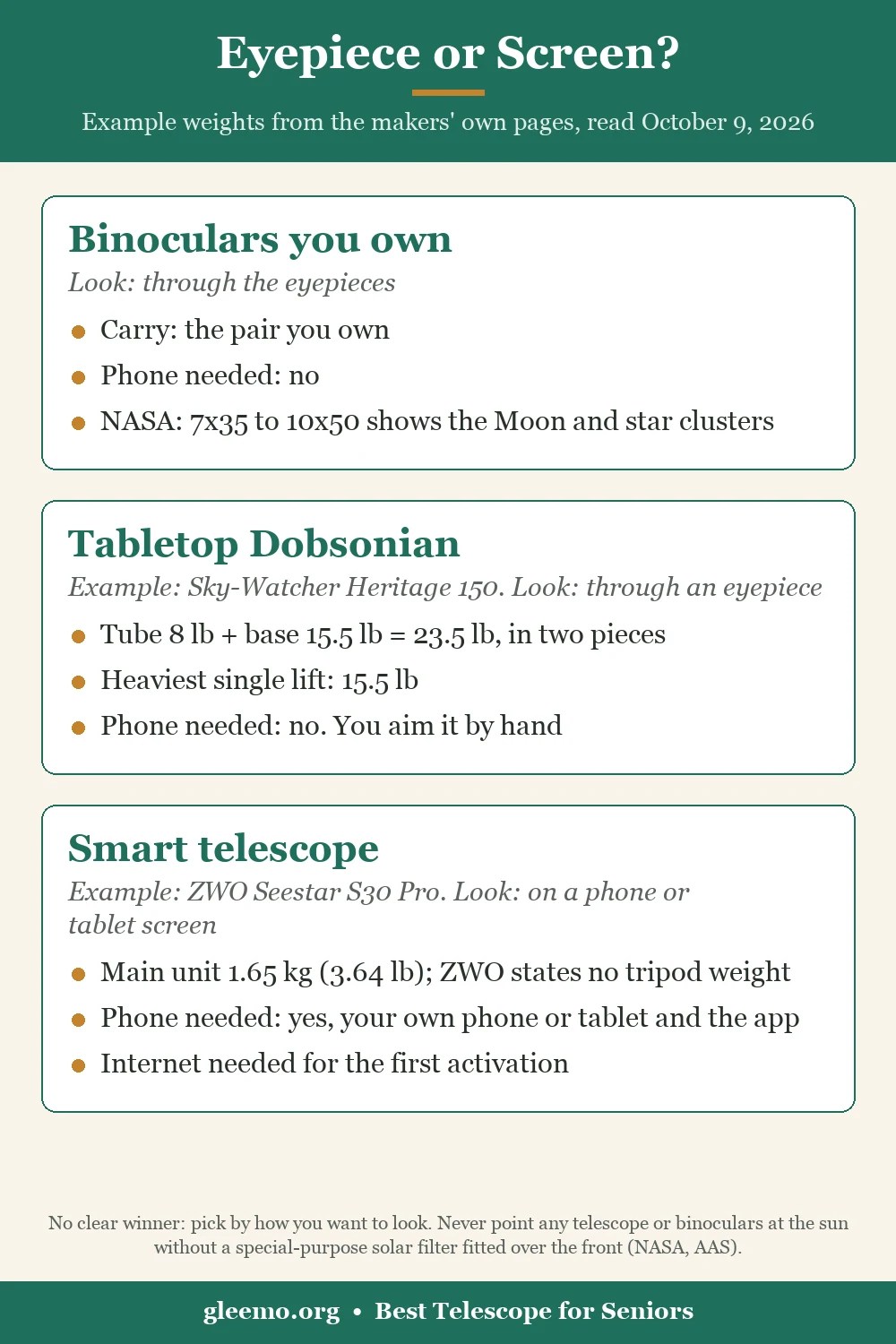
- Eyepiece or screen? Binoculars and a tabletop Dobsonian put the sky in your own eye. A smart telescope shows it on a phone or tablet, and its box has no eyepiece.
- Weight is the real question. Our Dobsonian example is two pieces, 8 lb and 15.5 lb; the smart telescope’s main unit is 1.65 kg (3.64 lb).
- Try before you buy. Some libraries lend telescopes, and NASA’s Night Sky Network has over 400 clubs.
- No clear winner. A screen is a different way to look, not a wrong one.
- The cheapest start may be on your shelf. NASA says binoculars from 7×35 to 10×50 give great views of the Moon.
Gleemo isn’t a doctor. The tips on glasses, chairs and lifting are about the equipment, not medical advice.
Smart Telescope vs Dobsonian vs Binoculars: One Table, Side by Side
One example per path; they are not the only choices.
| Binoculars you own | Tabletop Dobsonian | Smart telescope | |
|---|---|---|---|
| How you look | Through the eyepieces | Through an eyepiece | On a phone or tablet screen; no eyepiece in the box |
| Example and price | Your pair: $0. If buying: Celestron Cometron 7×50, $47.95 | Sky-Watcher Heritage 150 Tabletop Dobsonian, $309.00, an October promotion (list $355.00) | Seestar S30 Pro, $699.00 |
| Weight and lift | Cometron 7×50: 27.3 oz (774 g) | Tube 8 lb (3.63 kg) + base 15.5 lb (7.03 kg) = 23.5 lb (10.66 kg); heaviest lift 15.5 lb | Main unit 1.65 kg (3.64 lb); ZWO states no tripod weight |
| Can you use it seated? | Hand-held, so your chair is your choice | Sky-Watcher says nothing about sitting; try your own table | You watch a screen, so your chair is your choice |
| Needs a phone or Wi-Fi? | No | No | Yes: your phone or tablet and the Seestar app; internet for the first activation |
| Setup | Take them outside | Base on a stable table, tube in it, aim by hand | Install the app, activate online once, join its Wi-Fi |
| What you will see | NASA: the Moon, star clusters, Orion Nebula, Jupiter’s moons; Saturn’s rings are usually hard to see (Sky at Night) | The sky through an eyepiece; stars drift, so you nudge it (Sky at Night) | Live-stacked images (ZWO); planets "will appear relatively small" |
| The catch | Many find 10x or higher hard to hold steady (AAS) | Two pieces, no carrying case | Needs a phone or tablet; the highest price here |
Note: We read each maker’s page on October 9, 2026. The Heritage 150 price is Sky-Watcher’s "DOBtober Fest 2026" promotion, "for the month of October," and it may go back to the $355.00 list price after October 31.
Models and prices change often. We read each price on the maker’s own page on the date shown; check that page before you buy.
There is no clear winner. Pick the eyepiece if you want the view with your own eye and can carry 23.5 lb in two pieces. Pick the screen if you would rather skip the eyepiece and own a phone or tablet.
Start Free: The Binoculars You Own, a Library Telescope, a Star Party
These cost nothing and show which path fits.
The Binoculars You May Already Own
NASA’s Night Sky Network (2020) says binoculars "anywhere from 7×35 to 10×50" give great views of the Moon, star clusters like the Pleiades, large nebulas like Orion and even peeks at Jupiter’s moons.
A birding pair, such as the 8×42 and 10×42 models in our guide to binoculars for glasses wearers, sits inside NASA’s range. Stargazing guides lean toward 7×50 or 10×50, so a birding pair is a fine start for the Moon and bright clusters, not the classic stargazing spec.
Borrow a Telescope From the Library
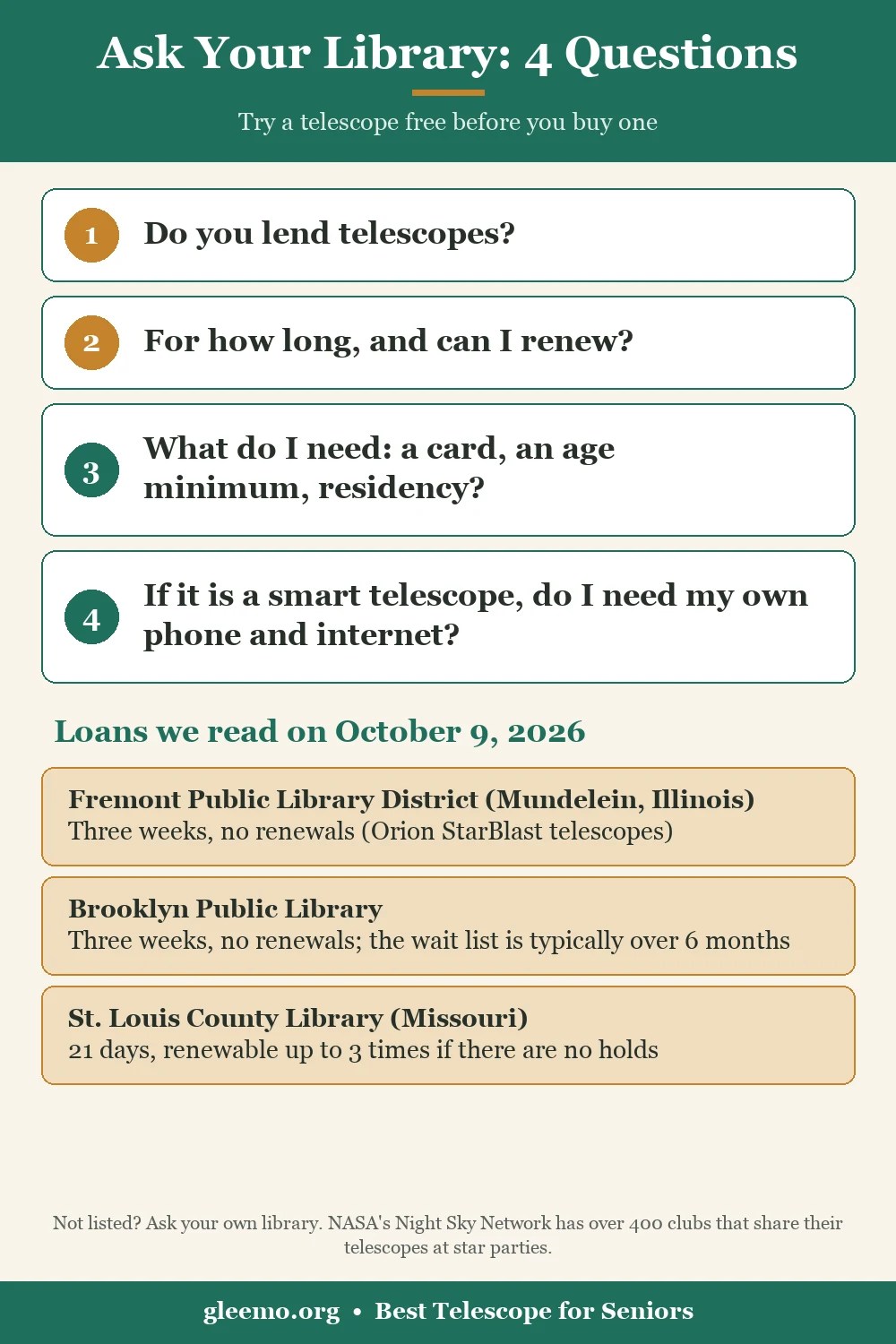
NASA’s Night Sky Network says some clubs and local libraries "even have telescope lending programs." On their own pages on October 9, 2026:
- Fremont Public Library District (Mundelein, Illinois): lends 16 Orion StarBlast telescopes ("Checkout is for three weeks with no renewals") and a Seestar S50, which requires the Seestar app on a smartphone or tablet and internet access.
- Brooklyn Public Library: free for three weeks, no renewals, and the wait list is "typically over 6 months." The telescope "weighs between 15 and 24 pounds."
- St. Louis County Library (Missouri): "Any adult library cardholder can check-out a telescope." Loans run 21 days, renewable up to 3 times if there are no holds.
Your own library may lend one even if it is not listed. Ask:
- Do you lend telescopes?
- For how long, and can I renew?
- What do I need: a card, an age minimum, residency?
- If it is a smart telescope, do I need my own phone and internet?
Libraries lend more than books; see our guide to library memory labs too.
Look Through Other People’s Telescopes at a Star Party
NASA’s Night Sky Network says it has "over 400 clubs to choose from" (page updated October 2, 2026), and its clubs "share our time and telescopes" with the public. Try its events calendar. A club is also the place to ask an astronomer about solar filters, as the AAS advises before you fit one.
Find a Night Sky Network club or star party
A Tabletop Dobsonian: The Real View, Through an Eyepiece
A Dobsonian is a simple mirror telescope on a swivel base; the Heritage has no motors. For a first telescope, NASA’s Night Sky Network says "a small reflector telescope on a tabletop or Dobsonian mount (rather than tripod) works out best." Our example is the Heritage 150.
Can You Use a Tabletop Telescope Sitting Down?
Sky-Watcher calls the Heritage a "tabletop design" and lists the eyepiece 28 inches above the base when the scope points straight up. It says nothing about sitting, so your table and chair decide; try yours first. Celestron says its own tabletop Dobsonian’s base can sit on "a stable platform, like a table or hood of a car, to raise it to a comfortable viewing height."
Who Carries It Outside?
Sky-Watcher lists an 8 lb tube and a 15.5 lb base, in two pieces. The base is the heaviest single lift. The tube collapses to 16.75 inches, and the page lists no carrying case. Carry a 15.5 lb load from your door to where it would sit before you buy.
What You Will See, and What Takes Practice
You aim by hand with a red-dot finder. A Dobsonian does not track the sky, and Sky at Night says "you’ll see stars move across the sky as you look through the eyepiece." Skip any store telescope that advertises huge power: NASA’s Night Sky Network calls 600x scopes "bad telescopes."
The same Heritage 150 (SKU S11710) is also on Amazon. Check the current price on Amazon.
A Smart Telescope: The Sky on Your Phone
A smart telescope finds targets for you and shows what it sees on your phone or tablet. Our example is ZWO’s Seestar S30 Pro. ZWO’s manual lists a tripod, a solar filter and a carrying case in the box.
Solar safety again. ZWO’s own solar warning protects the camera ("irreversible damage to the device"). For your eyes, follow NASA and the AAS: never point any telescope or binoculars at the sun without a special-purpose solar filter fitted over the front.
Are Smart Telescopes Cheating?
No. ZWO says the Seestar "captures real astronomical images and does not generate AI-created or synthetic images." The picture is built up by live stacking many exposures, a different experience from an eyepiece, not a fake one.
The Phone, Tablet and Wi-Fi Catch
You control the Seestar from its app on your own smartphone or tablet. The first activation needs an internet connection; after that, ZWO says, internet is "only needed for initial setup, firmware updates, and app downloads." Someone has to set up the app, and for a parent that may be you. Seestars come in two regional versions; the China version "is intended for activation and use exclusively within Mainland China, Hong Kong, and Macau," so buy from an official channel, as ZWO’s Where-to-buy page says.
The Lineup Keeps Changing
On October 9, 2026, ZWO’s US store showed the S30 Pro in stock and the older S50 as "Sold out." ZWO’s pages do not call it discontinued. Stock can change any day. The S30 Pro is also on Amazon. Check the current price on Amazon.
What About App-Guided and GoTo Scopes?
A GoTo scope points itself at a target you pick. An app-guided scope uses your phone to help you aim by hand. NASA’s Night Sky Network says many astronomers recommend avoiding a computerized telescope until you have learned the sky a bit better. For an eyepiece plus an app, Celestron’s StarSense Explorer 150mm tabletop Dobsonian was $599.95 on its page on October 9, 2026 and weighs 25 lb (9 lb tube, 16 lb base). Its dock needs a smartphone: "A tablet is too big to fit into the StarSense dock" (also on Amazon).
Best Telescope for Seniors With Glasses, a Bad Back or Sore Hands
Glasses and Eye Relief at the Eyepiece
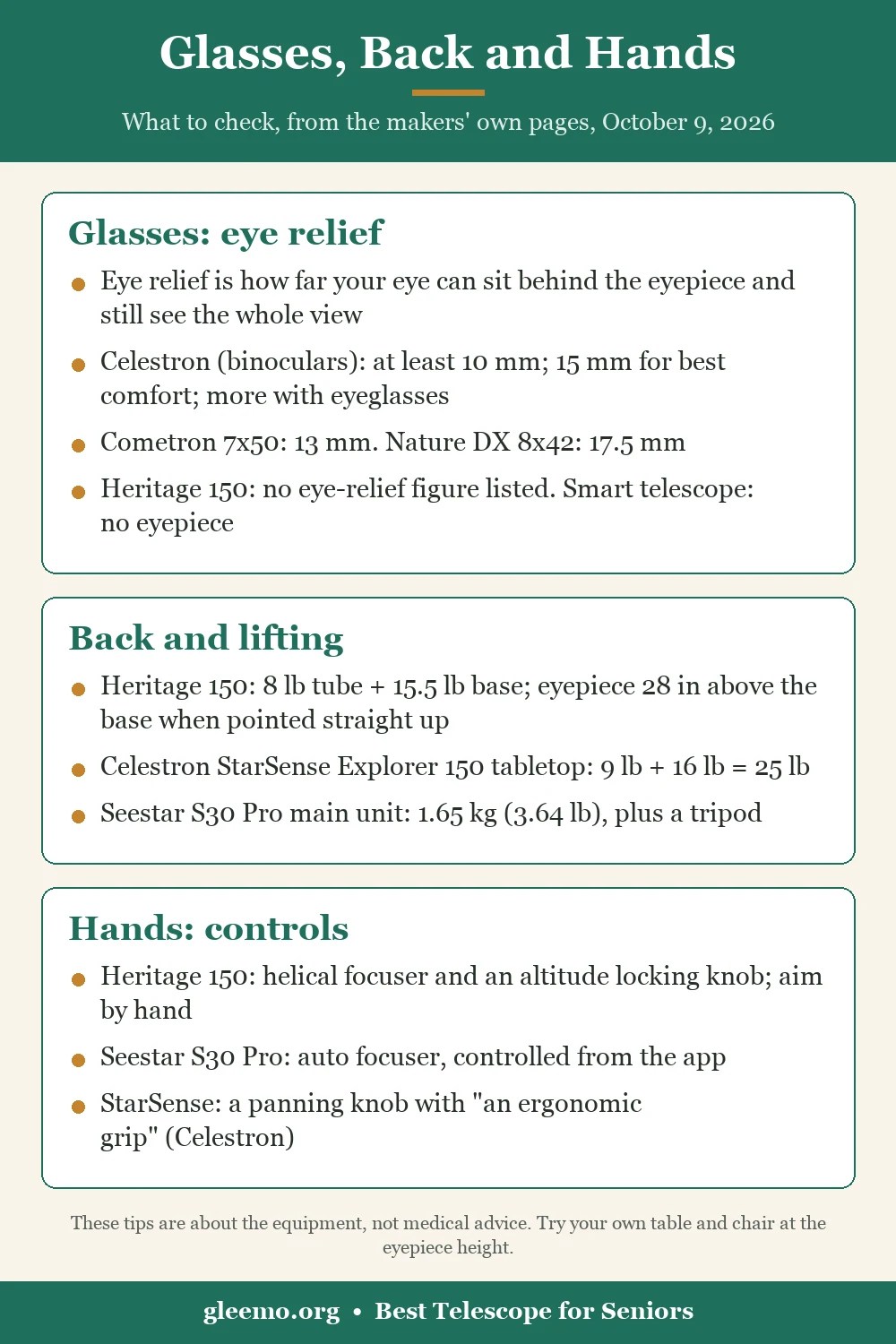
Eye relief is how far your eye can sit behind the eyepiece and still see the whole view. Celestron’s guide, written for binoculars and spotting scopes, says it "should be at least 10mm; 15mm will provide the best comfort, and you may need more if you wear eyeglasses." Celestron lists 13 mm for its Cometron 7×50 (the stargazing spec, also on Amazon) and 17.5 mm for its Nature DX 8×42, so the 8×42 has the longer eye relief of the two.
Sky-Watcher lists no eye-relief figure for the Heritage’s eyepieces, so we cannot say how they work with glasses. A smart telescope has no eyepiece to line up with.
Back and Lifting: Eyepiece Height, Seating and Trips From the Door
Decide how many trips from the door you will make. The Heritage is two pieces (8 lb and 15.5 lb), Celestron’s tabletop is 25 lb, and the Seestar’s main unit is 1.65 kg (3.64 lb) plus a tripod. Then try your own table and chair at the eyepiece height.
Hands: Focusers, Knobs and App Control
The Heritage has a helical focuser and an altitude locking knob. The Seestar has an auto focuser and is controlled from its app. Celestron says the StarSense’s panning knob provides "an ergonomic grip." Matching controls to your hands is the idea behind our fishing guide to gear that works with sore hands.
If You Are Buying a Telescope for Mom or Dad
- Ask first: eyepiece or screen? A telescope that doesn’t match how they want to look is the one that ends up in a closet.
- Try one free together. A library loan or a star party is the test drive.
- Know the return window. On their own policy pages (read October 9, 2026), ZWO’s US store, Sky-Watcher USA, Celestron and High Point Scientific each give 30 days. Restocking fees: 10% at ZWO on opened items (a Seestar must be activated online on first use); 15% at Sky-Watcher and Celestron if not like-new; "a minimum restocking fee of 10%" at High Point Scientific if not factory sealed. For Amazon, check the listing’s return window.
- Set it up together on the first clear night, so order early enough to do that before the holiday.
How We Built This Guide
We read each maker’s, library’s and NASA’s own page on October 9, 2026. ZWO, Sky-Watcher USA, Celestron and High Point Scientific supplied prices, weights and return policies; three libraries supplied lending rules; NASA and the AAS supplied safety rules. BBC Sky at Night Magazine supplied a few background points. We did not test these telescopes, and no price came from a review site or a reseller.
Frequently Asked Questions
Is a smart telescope worth it?
It can be, if you want a screen and own a phone or tablet. Borrow one first: Fremont Public Library District in Illinois lends a Seestar.
Are smart telescopes cheating?
No. ZWO says the Seestar "does not generate AI-created or synthetic images." The picture is built up by live stacking, a different experience from an eyepiece.
What is the easiest telescope to use?
The AAS says binoculars are "much easier to use than a telescope." A smart telescope does the finding for you. With a Dobsonian, you aim by hand.
What is the best telescope for people who wear glasses?
Check eye relief. Celestron’s binocular guide says 15 mm gives the best comfort, and you may need more with eyeglasses.
Can you use a telescope sitting down?
It depends on your table and chair. Sky-Watcher lists the Heritage’s eyepiece 28 inches above the base and says nothing about sitting, so try yours.
Do you need a phone for a smart telescope?
Yes. ZWO’s Seestar needs a smartphone or tablet and its app, plus internet for the first activation.
Where to Start This Week
Before you spend anything, take the binoculars you own outside on the next clear night, and ask your library whether it lends telescopes. Then use the table to choose: eyepiece or screen. Never point any telescope or binoculars at the sun without a special-purpose solar filter fitted over the front. More honest, jargon-free guides for the next chapter are waiting at gleemo.org.
Photo: Jul L. G. / Pexels
